- Home
- About Us
- Services
- Who We Serve
- Home service trades
- Specialist trades
- Exterior and remodeling
- Outdoor and site work
- Client Reviews
- Book a Strategy Call
Book More Window & Door
Installs With Google Ads
Google Ads can reach a homeowner the very afternoon they decide the drafty, fogged-up windows have to go. The trick is keeping the budget off single-sash repair and window-tint searches, steering it toward full-house replacements and door packages, and not trusting the account to someone who has never sat in on an in-home consultation. That is the whole job here, done by people who only market home service companies.
- ✓Each click traced to the job it booked, so you see which ads really fill your calendar
- ✓Spend weighted toward full-house replacements and door packages, not one-off glass repairs
- ✓Managed by a team that works only in home services, so budget isn't burned on junk searches
One 15-minute call. You get a clear plan built for your service area.
Next step: we'll text or call to schedule your 15-minute strategy session.
Google Ads built for window & door installers
Window & Door Marketing Run by HSC
Built for window and door installers of every size, from a two-crew shop to a showroom running several sales reps.
Where jobs slip away
Where Is Your Google Ads Spend Slipping Away?
Which of these sounds like your window and door business? Here's what we review first.
Visitors tap your ad, then bounce
- 1Does each ad land on a page about that exact job, or just on your homepage?
- 2On a phone, can visitors see your number and a call button without scrolling?
- 3Can they see real job photos, your reviews and the next step?
Our first moveA dedicated page per service, with the phone number up top
Build My Google Ads Planor phone us at (555) 010-0000
You're paying for searches that will never hire you
- 1Do your ads appear for "how to", "hiring", "cheap" or towns outside your area?
- 2How long since anyone reviewed your search terms list and blocked the bad ones?
- 3Does a one-window glass repair cost you the same per click as a full-house replacement?
Our first moveJunk searches blocked at launch, and bids aimed at the jobs you actually want
Build My Google Ads Planor phone us at (555) 010-0000
Google reports conversions. Your phone tells a different story
- 1Can you link every call to the exact ad and search term that drove it?
- 2Do you track what a booked job costs, or only what a click costs?
- 3Is the Google Ads account in your name, or your agency's?
Our first moveTracking on every ad, inside an account you own
Build My Google Ads Planor phone us at (555) 010-0000
Good lead, lost job: a competitor got back to them faster
- 1When a homeowner reaches out at 7 p.m. or while you're on a job site, how long before someone gets back to them?
- 2Does each lead get a phone call, a text and a same-day follow-up, or a single try?
- 3Is the homeowner you paid for also hearing from three other installers before your rep can dial?
Our first moveAn instant text to each new lead, same-day follow-up, and leads nobody else gets
Build My Google Ads Planor phone us at (555) 010-0000
Inside your report
How We Build Your Google Ads Campaign
Nothing hidden. Below is every piece we set up and manage inside your Google Ads account, and all of it points the same direction: signed window and door contracts on your calendar, not charges on your card.
Campaigns Built for Windows & Doors
- ✓Buying searches such as "replacement windows near me", "vinyl replacement windows cost", "sliding patio door replacement" and "fiberglass entry door", grouped by job type, each group with its own ad and landing page.
- ✓Each job type gets its own ad and message.
200+ Junk Searches Blocked at Launch
- ✓From launch we exclude "DIY", "tint", "screen repair", "parts", "jobs", "car window" and a long list of other searches that never sign.
- ✓Self-run window accounts often carry only a handful of exclusions.
- ✓Left open, that gap quietly drains your budget.
A Landing Page per Job
- ✓Every job type has a dedicated page carrying your reviews, energy ratings, warranty terms, financing offer, service towns, and a call button a thumb can't miss.
- ✓Designed so the visit ends in a scheduled in-home consultation, not a back button.
Budget and Bid Control
- ✓Spend is checked every day and shifted to whichever search terms, neighborhoods and times of day produce full-house replacement appointments, and away from repair-only clicks.
- ✓The budget stays put. The job size goes up.
Call and Form Tracking
- ✓Each call, form and click is tied to the keyword and ad behind it, so you can see which campaigns set full-house appointments and which only bring screen and glass questions.
Retargeting for Homeowners Still Shopping
- ✓Window buyers take their time.
- ✓Anyone who visited without calling sees your installs again on other sites and apps while they collect competing quotes.
- ✓That second look wins back estimates cold ads miss, and it costs far less per view.
Swipe through all 6 parts
Build My Google Ads Planor phone us at (555) 010-0000
Your live dashboard
Search Clicks Turned
Into Signed Window Contracts
When someone types "how much are replacement windows" or "new windows near me", your ad is waiting above the results. Each click is traced to the keyword and ad behind it, so the budget follows signed replacements, not browsers. Every client gets a live dashboard and phone app showing calls, forms and booked jobs as they happen.
See How You'd Book My Crews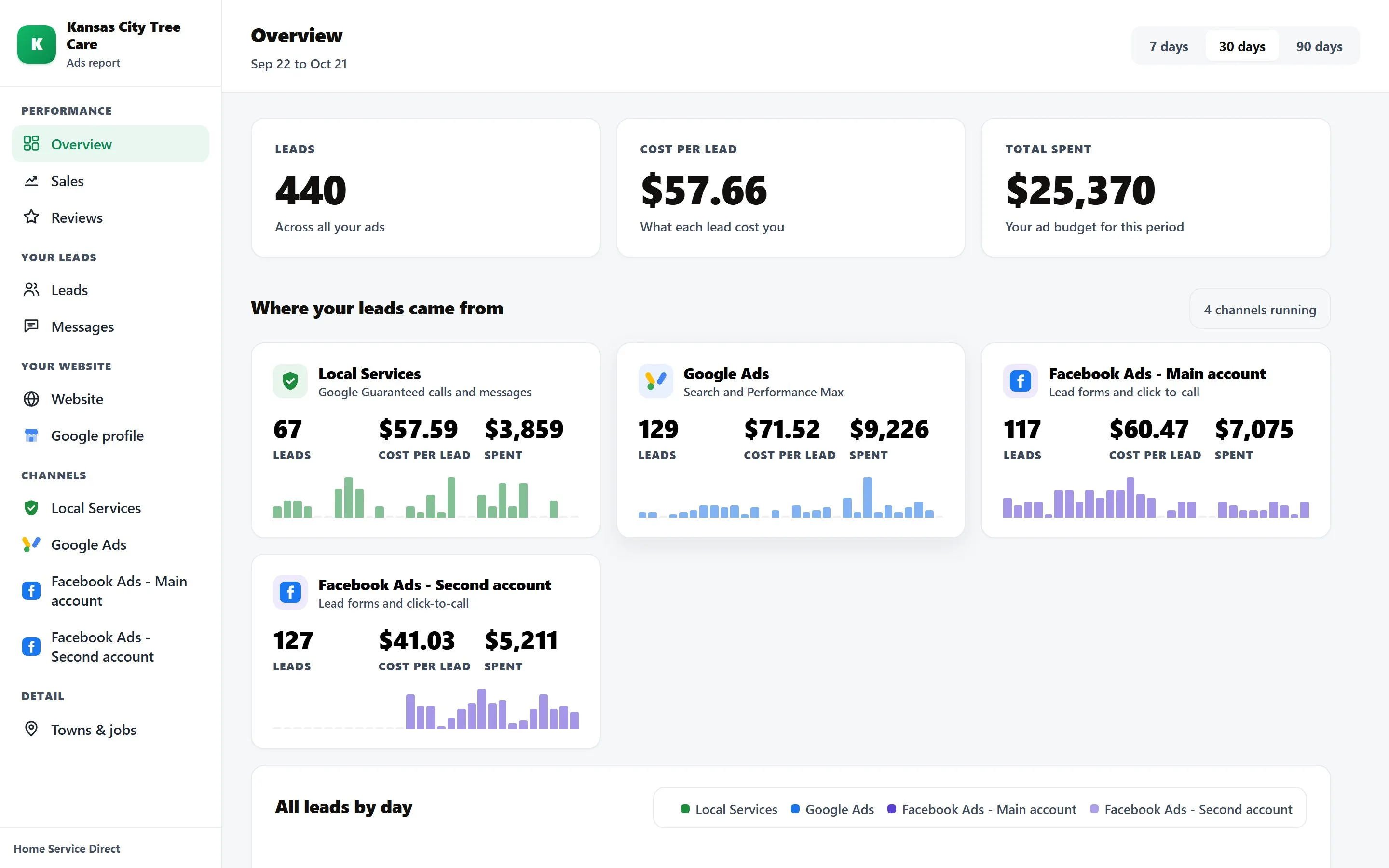
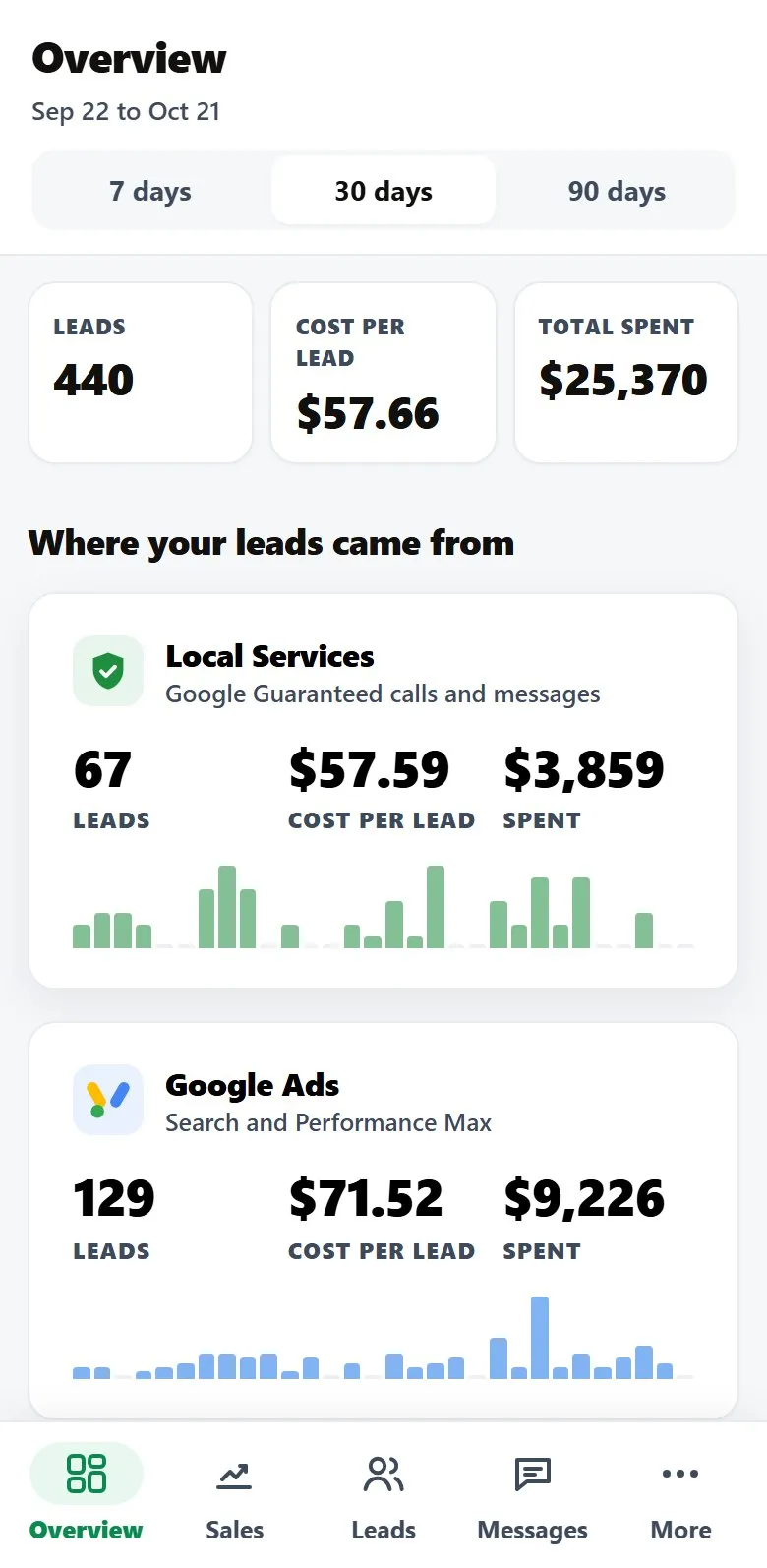
Example dashboard and phone app for a 30-day period. Sample data, shown so you can see the layout.
Spend goes to the searches behind real replacement projects: single-pane windows sweating every winter, seals that have fogged, a slider that sticks halfway. The ad appears when a homeowner wants a price on new units, not when someone is watching a video on resealing a frame. That means bigger tickets, better close rates at the kitchen table, and real revenue on the board.
Picture a full-house contract you can trace to a single search for "new windows for my house". Calls, texts and forms are each matched to the ad, the search term and the neighborhood they came from. You stop guessing which dollars turn into installs, and the budget follows the ones that do.
No drawn-out discovery phase. Once account access and tracking are in place, the campaigns go live, so a homeowner fed up with drafts and high heating bills reaches your phone. Paid search can bring calls in the first days after launch.
Swipe through all 3 points
Side by side
Your Google Ads Options, Compared. Only One Keeps Crews Busy.
There are three ways to handle Google Ads: run them yourself, hire a general agency, or use a team that works only in home services and watches the account daily. Here is how each option plays out when you sell windows and doors.
Vanguard Home Services Marketing
- Window & Door Keywords and Exclusions
- ✓200+ at Launch
- Job-Specific Landing Pages
- ✓One Per Service
- Spend Focused on Big Jobs
- ✓Full-House Focus
- Tracking Behind Every Lead
- ✓All of Them
- Window & Door Know-How
- ✓Home Services Only
- Google Ads Account in Your Name
- ✓Yours to Keep
- Commitment
- ✓Monthly Terms
Doing It Yourself
- Window & Door Keywords and Exclusions
- ~A Few
- Job-Specific Landing Pages
- ✕Just the Homepage
- Spend Focused on Big Jobs
- ~If You Find Time
- Tracking Behind Every Lead
- ~Spotty
- Window & Door Know-How
- ✓Knows the Trade
- Google Ads Account in Your Name
- ✓Yours to Keep
- Commitment
- ✓Month to Month
A Catch-All Agency
- Window & Door Keywords and Exclusions
- ~Canned List
- Job-Specific Landing Pages
- ~Usually the Homepage
- Spend Focused on Big Jobs
- ✕Rarely Adjusted
- Tracking Behind Every Lead
- ✕Just Clicks
- Window & Door Know-How
- ✕Every Industry
- Google Ads Account in Your Name
- ✕The Agency's
- Commitment
- ✕Long Lock-In
Swipe through all 3 options
Why Self-Run Google Ads Tend to Waste Budget
The usual setup is a short keyword list, a few negatives and the homepage as the destination. Clicks arrive, but many come from people typing "free", "how to" or "DIY", and the homepage never gives them a reason to pick up the phone.
Researching keywords, blocking hundreds of junk searches, keeping ad groups tight, building a page per service and adjusting bids every day takes hours each week. Few owners running crews have those hours to spare. The Google Ads accounts that book work are the ones someone is tuning all the time.
Window Clicks Are Not Worth the Same
A full-house replacement commonly runs well into five figures, and a three- or four-window order is still several thousand. A single glass repair might be a few hundred. The clicks for each cost roughly the same, so where the budget points decides whether the account pays.
We point keywords, bids and ZIP codes at the high-value searches, so spend follows full-house replacements and multi-window orders instead of one-off repair calls.
or phone us at (555) 010-0000
Why work with us
How We Get You Ranked Above Everyone on
Google Ads
Window and door ads need weekly attention. We set up the campaigns, draft every ad, add the exclusions, build the landing pages and trace each call to a signed job, so incoming calls are for projects worth running a crew on. Every account is handled by people who work only in home services.
Tight Window & Door Campaigns
Campaigns follow the way homeowners really search, "replacement windows cost", "sliding door installation", "energy star windows", in small ad groups so every ad and page matches the job. No broad "windows" bucket soaking up the wrong clicks.
200+ Blocked Searches to Stop Wasted Spend
From launch we block searches like "DIY", "tint", "screen", "parts", "jobs" and "cleaning", and the list grows weekly. Accounts that owners run themselves often carry only a few exclusions, and that gap pays for clicks from people with zero plans to replace a window.
Pages That Book the Consultation
A click only pays if the page gets a call. Your traffic lands on single-purpose pages, one per job, showing your reviews, energy ratings, warranty, towns served and a large phone number, so more visits end in a scheduled in-home consultation.
Spend Aimed at Full-House Jobs
Every day we check spend and move it to the terms, neighborhoods and times of day behind full-house and multi-window projects, and trim the clicks that only want one pane fixed. Same budget, more of the contracts that keep installers busy.
Higher Quality Score, Lower Click Costs
When ad groups are tight, the ad matches the search and the landing page matches the ad, Google scores the account higher and charges less for the same position. We tune that weekly so the budget reaches more homeowners.
Tracking That Shows Which Ads Booked Jobs
Calls, forms and clicks are each tied to the exact ad and search term that started them. You see which campaigns set full-house appointments and which bring repair questions, and the budget moves to the ones that sign.
Swipe through all 6 reasons
The process
Three Steps to a Fuller Schedule
When a homeowner finally commits to new windows, they usually call the first credible company they find. These three steps make you that company instead of the third quote that shows up late.
Book Your Call
Whether your Google Ads are wasting money on bad clicks or you've never tried them and want to skip the expensive learning curve, a short call will show you where to start. 15 minutes, no sales deck.
Leave With a Plan
We study replacement window and door demand around you, what a click and a signed job ought to run locally, and which keywords and exclusions we'd build on. You leave the call knowing where your next full-house jobs will come from, with a plan built for your territory.
Sign More Installs
Ads go live, calls reach your phone, your reps run more in-home consultations, and your installers have work lined up well in advance, letting you win more full-house projects and become the first window company local homeowners think of.
Swipe through all 3 steps
Pick a Time for My Callor phone us at (555) 010-0000
FAQ
Google Ads for Windows & Doors: Your Questions
What should a window company budget for Google Ads?
There's no package number. Clicks in this trade run higher than in most others because the tickets are bigger, so your budget hinges on your market, how hard the national brands bid it up, and how many consultations your reps can run each week. We work it out with you from your average job value and close rate.
What matters more than the budget is the cost per signed job. A full-house contract that took only a modest amount of click spend makes for a strong month. That's the number we manage to, so spend stays tied to real work.
I tried Google Ads once and lost money. Why would this be different?
Owners tell this story a lot, and the cause tends to be the same short list: a loose keyword list, too few junk searches filtered out, everything crammed into one campaign, and clicks sent to a homepage that never asks for the call.
We rebuild the account with ad groups split by window and door job type, a full exclusion list from launch, and landing pages built to set in-home consultations. Same platform, different setup, and the setup is what separates booked jobs from wasted spend.
How soon can Google Ads bring in jobs?
Search ads start showing as soon as they're approved, so first calls often come in within days. Unlike SEO, there's no three-month ramp-up before the phone rings.
The first weeks are for tightening: cutting search terms that don't book and moving spend to the ones that do. Window buyers often get quotes now and sign weeks later, so expect some lag between the first calls and the first contracts. Within the first month the account usually settles into a steady, readable pattern.
How do you stop tire-kickers from eating my budget?
We start with a full list of exclusions at launch, "DIY", "tint", "screen repair", "cleaning", "jobs" and similar, so people who were never buyers don't see you. After that, someone reviews the search term report each week and adds to it as new junk appears.
We also narrow targeting to the ZIP codes you want and bid harder on replacement and installation searches, so the money follows the jobs that pay your crews.
Is the Google Ads account mine?
Yes. It's set up in your name and stays with you if we stop working together. We run it day to day, but your account, your data and your campaign history are never held back from you.
Many agencies build campaigns inside their own accounts, so you leave with nothing when you cancel. We don't. Our terms are month to month, and everything we build belongs to you.
My last agency let me down. Why would you be different?
Because home services is all we do. We already know how homeowners shop for windows, the seasons that move demand, and which searches turn into in-home consultations. A general agency would be learning your trade on your budget.
There's no long contract, the account is in your name, and each call is tied to the ad that produced it. You can check what your budget is doing yourself instead of relying on our say-so.
Explore more
More Ways We Market Window & Door Companies
Window & Door Leads
Exclusive window and door appointments that go to you aloneRead moreWindow & Door Local Service Ads
Calls from the Google Verified spot, sent only to youRead moreWindow & Door SEO
Climb Google Maps in the towns you serveRead moreSwipe through all 3 pages
Next step
Want Your Install Crews Booked Out?
Take 15 minutes with us. You'll see how much window and door search demand exists around your towns, and the gap between you and the company currently capturing it.
After You Book
We pull replacement window and door search volume for your ZIP codes, check who else is bidding, and find the neighborhoods with older homes and higher values.
We show you the call volume to expect, what a signed install should cost from paid search, and how much revenue that puts on your schedule.
Your campaigns launch and the phone starts ringing. No long contract, cancel with 30 days' notice.
No Long Contracts: we keep your business by keeping your phone ringing. No long-term contract, no setup fees, cancel with 30 days' notice, and the account and every lead stay yours.
One 15-minute call. You get a clear plan built for your service area.
Next step: we'll text or call to schedule your 15-minute strategy session.
How Google Ads for Windows & Doors Turn Into Signed Jobs
If you sell windows and doors, Google Ads is the quickest way to reach homeowners at the moment they search. Set up well, window and door PPC brings buying calls all week. Set up badly, it drains the budget one useless click at a time. Closing that gap is what Google Ads management for window companies is for, and this guide walks through how.
Two Grand on Clicks, Two Small Quotes
Owners tell versions of this all the time. They switched Google Ads on with a thin keyword list and almost no exclusions, pointed every click at the homepage, and thirty days on they were out a couple thousand dollars for a pair of repair calls. Google wasn't the problem. The build was. The same account, set up properly, is one of the most dependable ways to get a homeowner who is tired of fogged, drafty windows to call you at the moment they're ready. The sections below explain what changes.
Why Bargain Clicks Usually Cost You the Most
Here's the trap. Owners chase cheap clicks on wide-open terms such as "windows" or "window companies", since the price per click looks friendly. Those terms pull in everybody: the homeowner pricing a full-house replacement and a tenant hunting for a new screen, at the same rate. A big share of the budget goes to people who will never sign.
A click on "replacement windows cost" or "best energy efficient windows" runs higher, sometimes much higher. But it comes from an owner with a real problem and the means to fix it, who is close to calling. A pricier click that sets in-home consultations beats a cheap one that burns your rep's afternoon. The click price is not the figure to manage.
Bottom line: stop chasing bargain clicks. One that never turns into a consultation is the most costly line in the account.
Exclusions Make or Break a Window Budget
If one thing separates a window account that books from one that leaks, it's the negative keyword list: the searches you tell Google never to show your ad for. Without it, a "replacement windows" ad fires on "window tint", "window cleaning", "car window repair", "window AC unit", "how to replace a window screen" and many more dead ends.
Self-run window accounts often carry only a handful of exclusions. We launch with a long list covering "DIY", "tint", "parts", "jobs", "cleaning", "screen" and similar non-buyers, then read real search terms every week and keep adding. That one habit can cut a large share of wasted spend, and the money goes back into clicks that set full-house appointments.
Ignore Cost Per Click. Watch Cost Per Booked Job.
The platform shows cost per click first, and it's the wrong number to chase. The one that runs your company is cost per signed job. You get it by following clicks to calls, calls to in-home consultations, and consultations to signed contracts.
Here's a simple example. You spend $2,400 and get sixty clicks. Fifteen of them call, you sit eight consultations and sign three. That's $800 of ad spend per signed job. If an average contract is $11,000, that $2,400 became $33,000 of work. Bargain clicks that never ring the phone would have produced nothing. Measure every campaign by its cost per signed job, which means following the full path, not only the first step.
The Ad Earns the Visit. The Page Earns the Appointment.
The most common DIY mistake is pointing paid clicks at the homepage. A homepage tries to do everything at once, and someone weighing three installers won't dig for your number or your warranty. Most leave, and every one of those visits was billed.
A click only pays off if the landing page gets a call. So every job type gets its own page, written around the search, with your reviews, ENERGY STAR and U-factor details, warranty, real install photos and a phone number nobody can miss. Sending the same traffic to a page built for conversions can noticeably raise the share that turns into scheduled consultations. The ad brings the visitor. The page sets the appointment.
Quality Score and the Ad Auction: Ranking Higher for Less
Every search triggers an auction, and the highest bid doesn't automatically win. Google favors ads closely tied to what was typed that land on a relevant, fast page. That rating is called Quality Score, and a tightly built window account can use it to beat a messier rival for position while spending less on each click.
That's why we split campaigns by job type, repeat the searched phrase in the ad, and put a matching page behind it. A "sliding patio door" search lands on the patio door page. A "fiberglass entry door" search lands on the entry door page. When search, ad and page line up, Google charges less for the top spot. One broad, everything-in-one campaign does the reverse and makes you overpay just to stay visible. Structure isn't busywork. It's how you hold the top position without draining the budget.
Window Buyers Take Their Time. Retargeting Keeps You in the Running.
Nobody signs a five-figure window contract after one click. Homeowners read reviews, compare vinyl and fiberglass, sit through two or three consultations, and decide weeks later. If one paid click is your only touch, you're betting the sale on catching them at exactly the right moment, and that usually doesn't happen.
So we run retargeting alongside search. Someone who looked at your page and left without calling keeps seeing your installs and reviews while they shop, and on the day they choose, your name is already familiar. A second and third touch costs far less than a new click and keeps you on the short list.
Without Call Tracking, You're Guessing What Worked
If you can't see which ad produced the full-house job, you'll eventually cut the campaign that was quietly paying for everything. Call tracking links every call and form to the ad, keyword and ZIP code behind it. You can listen to the calls, see which searches set replacement appointments, and spot the ones that only bring screen and glass questions.
With that data, we move money toward what's working every week instead of guessing. If an agency can't play you the call recordings or tell you what each booked job cost, ask why. Campaigns that really produce work have nothing to hide.
Why Window Ad Accounts Lose Money, and How to Avoid It
When owners tell us Google Ads lost them money, the cause is usually several small problems piled on each other: a thin keyword list, few exclusions, one catch-all campaign, clicks sent to the homepage, nothing following up with visitors, and no tracking to show what booked. Any one is survivable. All of them together guarantee a bad month.
The fix is discipline, not tricks. Ad groups by job type, a long exclusion list that grows weekly, a dedicated page for each job, daily spend and bid control aimed at full-house work, retargeting for shoppers, and tracking on every lead. That's the gap between an account that slowly drains you and one that keeps installers booked. The platform is identical. The work behind it decides everything.
PPC, pay-per-click, paid search, Google Ads for window installers: the label doesn't matter. What matters is whether your search ads produce signed jobs or wasted spend. That's the only scorecard we use.
Put simply, a well-run window and door account keeps homeowners who are ready to sign calling you, and a neglected one just buys traffic. Turning ad spend into scheduled installs is the whole point of managing it.
Home services are the only industry we market. We keep campaigns narrow, cut wasted spend, send every click to a page built to set the in-home consultation, retarget the shoppers, and trace each lead to the job it produced. The Google Ads account is in your name, and there is no long contract because we'd rather earn each month than hold you to a term. You always see what the spend produced. If your crews have gaps on the calendar, that's what we fix.
Build My Google Ads Plan
The marketing team for home service contractors, and nobody else.
Services
Explore
Get in Touch
Ready for Google Ads That Fill Your Install Calendar?
Spend 15 minutes with us and see what it would take to get your window company above the competition on Google where you work, without wasting budget. No long-term contract, no hard sell.