
- Home
- About Us
- Services
- Who We Serve
- Home service trades
- Specialist trades
- Exterior and remodeling
- Outdoor and site work
- Client Reviews
- Book a Strategy Call
Exclusive Tree Service Leads From People Who Already Picked You
Paid for Angi leads, tried Google Ads, or trusted an agency and came away with nothing? That is common. We run campaigns under your own name, so every lead calls you alone and no other crew gets a shot at it.
- ✓Removal and trimming leads that belong to you, not a form Angi resells to five crews
- ✓Campaigns live in days, not after a months-long onboarding
- ✓Month to month, so we keep you by booking work
One 15-minute call. You get a clear plan built for your service area.
Next step: we'll text or call to schedule your 15-minute strategy session.
Where jobs slip away
Why Are Your Tree Service Leads Slipping Away?
Spot the problem your tree company is dealing with, and see where we look first.
Homeowners with a dying tree only find you once it falls
- 1Look up "tree removal near me" while standing in one of your towns. Are you in every top slot on that page: Local Service Ads, the map listings and the paid ads?
- 2Does your Google profile name every tree service you sell, show real photos of your crane and bucket truck, and pick up fresh reviews each month?
- 3Do you depend on a single lead source? Once the storms stop, there is nothing behind it.
Our usual first moveLSA plus a tuned-up Google profile, then removal-focused Google Ads
Start My Exclusive Leadsor phone us at (555) 010-0000
Angi sold that same homeowner to several other companies
- 1Do your Angi, HomeAdvisor or Thumbtack leads also land in the inboxes of three, four or five rival tree companies?
- 2For each lead source, can you name the cost per booked job, or just the price per lead?
- 3Do homeowners push your price down because they're holding several other bids?
Our first moveLeads from ads in your own name, so no other company gets that homeowner
Start My Exclusive Leadsor phone us at (555) 010-0000
Your ad money buys $200 trims instead of $5K takedowns
- 1Do your ads bid on a vague word like "tree", or on "tree removal cost" and "emergency tree removal"?
- 2Are your ads reaching apartment renters, or owners of $500K+ homes with big, mature trees on the lot?
- 3Do your clicks go to a removal page with the phone number up top, or just to your homepage?
Our usual first moveGoogle Ads tilted toward removals and storm calls, plus Facebook ads for big wooded lots
Start My Exclusive Leadsor phone us at (555) 010-0000
Good lead, lost job: a competitor got back to them faster
- 1When a homeowner reaches out at 7 p.m. or while you're on a job site, how long before someone gets back to them?
- 2Does each lead get a phone call, a text and a same-day follow-up, or a single try?
- 3Are you buying leads three other tree crews also bought, then fighting over price before the first visit?
Our first moveAn instant text to each new lead, same-day follow-up, and leads nobody else gets
Start My Exclusive Leadsor phone us at (555) 010-0000
Six channels, one lead system
How We Build Exclusive Tree Leads Every Month
Betting the whole month on one source is how tree companies end up idle. We run up to six channels, and each one brings a different kind of work, from big takedowns to planned pruning. When one goes quiet, the rest keep your phone busy.
What Kind of Tree Work Each Channel Brings
Below is how every channel works, what it delivers and which tree jobs it tends to put on the calendar, from storm emergencies to scheduled pruning:
Google Search Ads
Catch homeowners the moment they search
What you get
- ✓Appear the moment a homeowner types your service into Google and is ready to hire.
- ✓A dedicated page for each job that turns clicks into calls.
- ✓Every call tracked and recorded.
- ✓Calls today from homeowners ready to hire.
What it brings you: callers ready to book
Google Ads (Search)
- ✓Landing pages written for tree work, so far more visitors pick up the phone than on a generic page
- ✓Searches like "tree house" and "tree climbing gym" get blocked before they cost you
- ✓Higher bids on "stump grinding" and "tree removal cost", lower bids on small-ticket terms
- ✓Weekly cleanup brings cost per booked removal down over time
- ✓Lead volume tuned to how much work your crews can take
Facebook & Instagram Ads
Be the familiar name in town
What you get
- ✓Put short videos of your crews and finished jobs in front of local homeowners early.
- ✓A strong fit for pruning plans, seasonal work and getting your company name known around the neighborhoods you serve.
What it brings you: demand before they search
Facebook & Instagram Ads
- ✓Your own crane picks and bucket-truck clips, the kind of before-and-after people stop to watch
- ✓Reach owners of $500K+ homes on wooded half-acre lots, not people in apartments
- ✓Retargeting reminds homeowners who got your estimate and went quiet
- ✓Often cheaper per lead than search
- ✓Pruning, trimming and large-yard removal requests
Local Service Ads (LSA)
Top-of-page spot with the Google Verified badge
What you get
- ✓Show up above the map when people search "emergency tree service" or "tree removal near me", where the callers are most ready to book.
- ✓After a storm, this is where urgent calls become same-day jobs. Top-of-page placement, you pay by the lead, and the caller reaches only you.
- ✓We take care of verification, bidding, lead disputes and replies to reviews.
What it brings you: badge-backed phone calls
Local Service Ads (LSAs)
- ✓Listed first when storm damage sends people searching
- ✓One call to you, not a form shared with five
- ✓A top LSA slot means the family with an oak on the garage dials you first
- ✓We dispute spam and wrong-number leads so you can get credit back
- ✓Direct calls about removals, yours alone
Google Business Profile SEO
Show up on the map across your service area
What you get
- ✓Earn a map pack spot for searches like "tree removal" plus your town, where a large share of local clicks go and where storm searches turn into calls.
- ✓Calls you earn instead of rent, which build on each other and pull down your average cost per lead month after month.
What it brings you: calls without click fees
SEO & Organic Search
- ✓Climb the map for "tree service" and "stump grinding" in each town you serve
- ✓Grow the review count that wins over a homeowner comparing three bids
- ✓Consistent listings on the directories people check before letting a crew near their roof
- ✓Organic calls you own, which keep coming even in months you cut ad spend
- ✓Your cost per removal keeps falling while ad prices hold steady
Direct Mail
Land in the mailboxes of your best neighborhoods
What you get
- ✓Reach the neighborhoods where your best jobs live.
- ✓Three-piece mail sequences with QR codes that open a matching landing page.
- ✓Well suited to reaching owners of large, tree-heavy properties in the zip codes you choose.
YouTube Ads
Show local homeowners your crews at work
What you get
- ✓Short videos of your crews, rigging and cleanup that show homeowners you know the work.
- ✓Appear while local homeowners watch yard and home videos, so you are the name they remember.
Swipe through all 6 channels
Start My Exclusive Leadsor phone us at (555) 010-0000
Your live dashboard
Crane Pick Monday, Storm Cleanup Tuesday,
Booked Weeks Ahead
Each lead belongs only to you, unlike the form Angi passes to four other crews. Below is the kind of dashboard and phone app where your tree leads show up.
See How You'd Book My Crews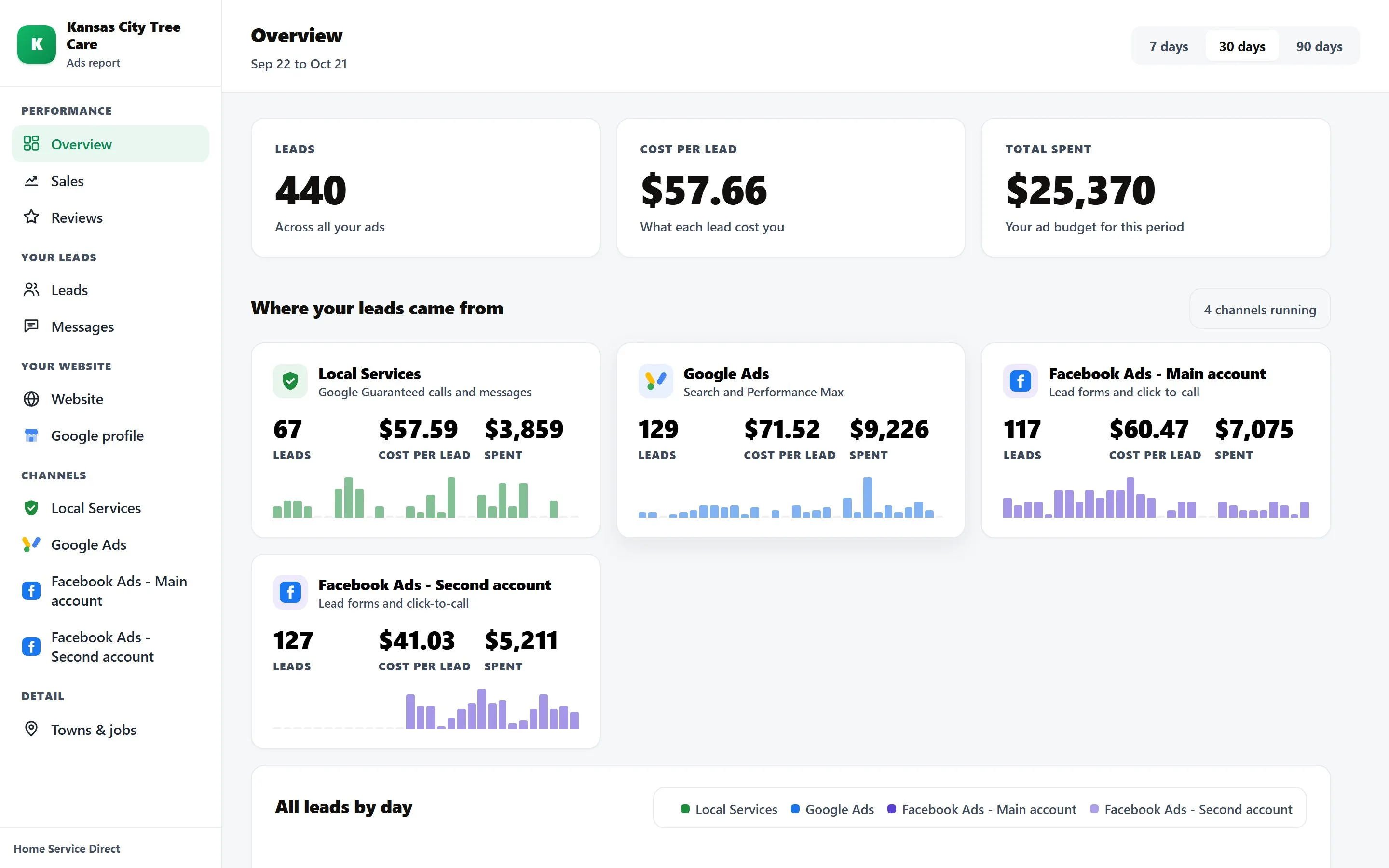
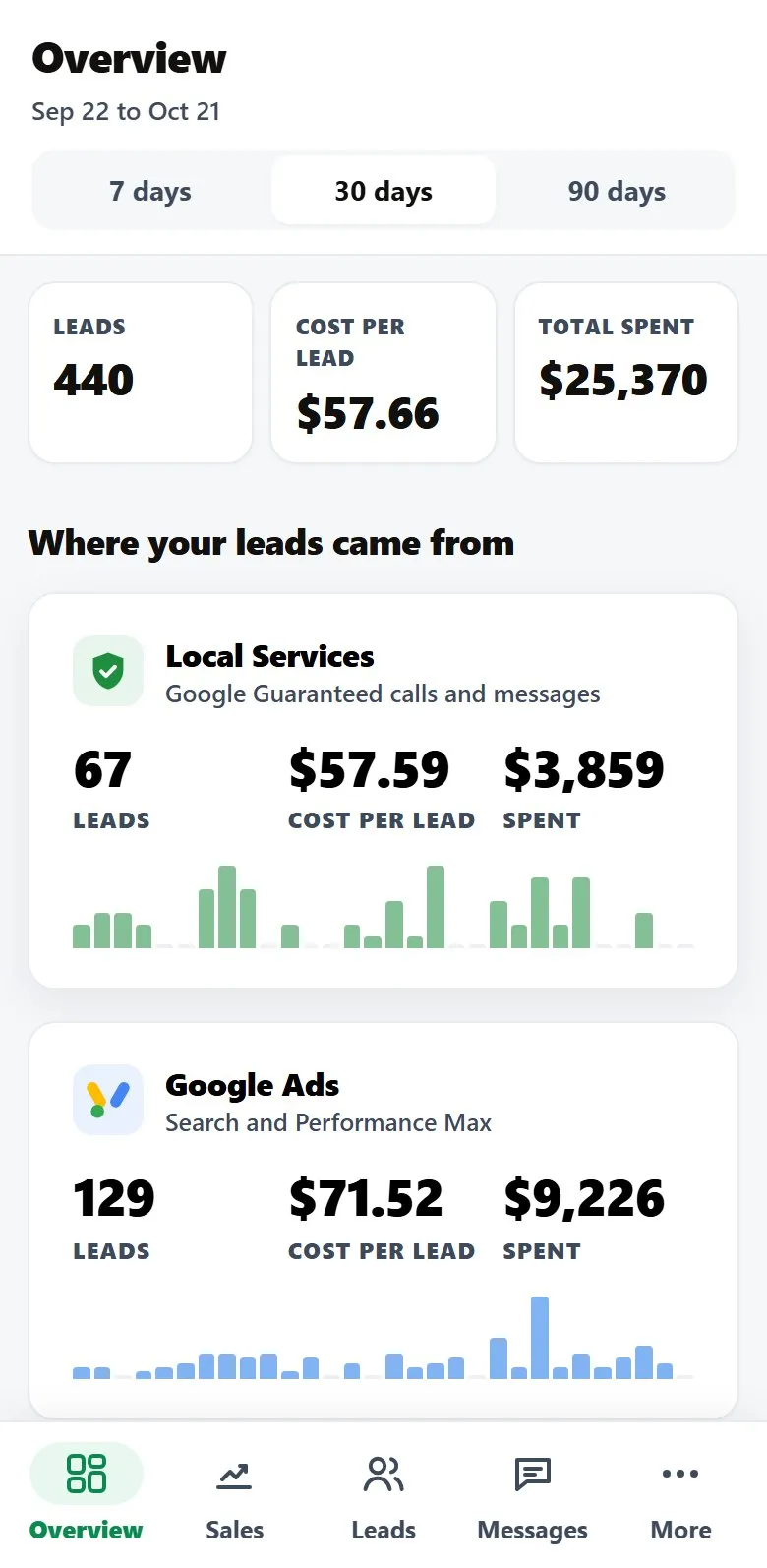
Example dashboard and phone app for a 30-day period. Sample data, shown so you can see the layout.
Nobody else gets your leads, so there are no four competitors quoting the same job. The leaning oak over the garage, the storm mess, the big takedown. Larger tickets, more estimates that close and real revenue on the schedule.
An emergency removal search might cost you $48 and turn into a $5K oak takedown, and you should be able to see that happen. We tie each call, text and form to the ad, keyword and zip code it came from. You learn which dollars book work and which leak, and the budget moves to where the money is.
There is no three-month planning phase. Your tree campaigns go live in the first week, so the next time high winds drop limbs on roofs across town, yours is the number homeowners dial. Other agencies are still scheduling kickoff meetings.
Swipe through all 3 points
Side by side
Lead Sources Side by Side
There are three common ways to find more tree work. Only one puts every lead in your hands alone, under your own name, with nothing locking you in.
Vanguard Home Services Marketing
- Who Gets the Lead
- ✓Only You
- Specialists in Tree Service
- ✓Tree-Focused
- Results Tracked to Booked Jobs
- ✓Every Job Tracked
- Commitment
- ✓Monthly Terms
- Channels Covered
- ✓Six Channels
- Account Ownership
- ✓All Yours
- Typical Close Rate
- 70-80%
Typical Agencies
- Who Gets the Lead
- ✓From Your Ads
- Specialists in Tree Service
- ✕Every Industry
- Results Tracked to Booked Jobs
- ✕Not Tracked
- Commitment
- ✕Long Lock-In
- Channels Covered
- ~One or Two
- Account Ownership
- ✕The Agency's
- Typical Close Rate
- 45-55%
Shared Lead Sites
- Who Gets the Lead
- ✕Sold to Several
- Specialists in Tree Service
- ✕Not Trade-Specific
- Results Tracked to Booked Jobs
- ✕Not Tracked
- Commitment
- ~Lead Count Only
- Channels Covered
- ✕Their Platform Only
- Account Ownership
- ✕The Platform's
- Typical Close Rate
- 25-35%
Swipe through all 3 options
Exclusive or Shared: Running the Close-Rate Numbers
A shared lead goes out to several contractors at the same moment. The homeowner gets swamped, and few of those leads ever close. Exclusive tree service leads reach one company, so there is no bidding war and no race to dial.
Example: ten shared leads at $30 apiece ($300) closing at 7% gets you 0.7 jobs. Five exclusive leads at $60 apiece ($300) closing at 75% gets you 3.75 jobs. Identical spend, about five times the work.
Why One Lead Is a $500 Job and Another Is $5,000
The type of job matters too. A removal often brings in several thousand dollars, many times what a $300 to $800 trim pays. When leads are sorted by service, you can put your effort into the work that pays most.
We aim at big removals, storm damage and hazard trees, not just pruning requests worth $200.
or phone us at (555) 010-0000
Why work with us
Tree Lead Generation
Built for Tree Companies Ready to Grow
Filling your phone with good calls is our whole job, and home service is the only industry we do it for. Removals, pruning, stump grinding, storm cleanup, and contract work for HOA boards and property management firms. Every call is exclusive and screened, never the recycled forms Angi and Thumbtack pass around to five competitors.
Built Only for Home Service Companies
Whether you run one bucket truck or several crews with chippers and a crane, we understand what gets a homeowner with a rotting oak over the house to pick up the phone and say yes.
Campaigns Can Go Live Within Days
We open with the channels that ring the phone fastest, usually LSA and paid search, then layer in what keeps calls coming year after year, like map rankings and reviews.
No Long Contract. Stay Because It Works.
No lock-in, ever. We have to earn your business again every month, with numbers you can check yourself.
Six Channels Running Around the Clock
Google Ads, LSA, SEO, Facebook, YouTube and direct mail. If one dips, the others keep tree calls coming and crews on the schedule.
Every Lead 100% Yours
No sharing with five rivals the way Angi and Thumbtack do. Each lead comes to your business and stops there.
Month to Month, Nothing Hidden
Cancel with 30 days' notice. We do not need a long-term contract to keep you. If the calls are booking, you will want to stay.
Swipe through all 6 reasons
From the owners
Owners Who Grew With Us
Real owners, on camera, in their own words. Not an anonymous percentage.
The process
Three Steps to a Fuller Schedule
After every storm, the big removals go to whichever crew the homeowner reached first. These three steps make that crew yours, instead of the one hearing about the job a week later.
Book Your Call
If your trucks sit in the yard between storms and the phone mostly rings for $100 stump jobs, let's talk. A 15-minute call with home service specialists, and no slide deck.
Leave With a Plan
We look at removal and pruning demand near you, which channels catch the rush after a storm, and what a fair price is for each exclusive call. You leave knowing where your next removals will come from, with a plan built for your towns rather than a template.
Land Bigger Removals
Exclusive calls start coming in, estimators stay busy and crews book out for weeks. You land more $5K takedowns and crane work, and you become the first tree company people in your area think of.
Swipe through all 3 steps
Pick a Time for My Callor phone us at (555) 010-0000
FAQ
Tree Service Leads: Common Questions
What does a tree service lead cost?
Typical ranges by channel:
- Local Service Ads: often $35-85 per call
- Facebook and Instagram: often the lowest cost per lead
- Google Search: often $45-85 per lead
- YouTube Ads: low cost, builds your name
- SEO: no per-lead charge once it's built
- Direct Mail: costs more, picks zip codes
Each one is far better than a shared lead from Angi, and every lead belongs to you alone.
Is this any different from Angi and HomeAdvisor?
Angi can send one dead-oak removal to several crews at once. You scramble to call first and get squeezed on price before the truck leaves the yard. Our leads come from your own ads and listings, so only you hear from that homeowner. We also run several channels instead of relying on one marketplace, so calls continue after storm season. And there is no long contract, so if it stops working you can cancel with 30 days' notice.
How soon will my first tree lead come in?
Paid channels like Google Ads and Local Service Ads can bring calls within days of launch, once your accounts are approved. We build and launch quickly rather than spending a month on planning, and map rankings follow over the next few months.
I've tried Facebook or Google ads and got nothing. Why try again?
Usually the platform was fine and the setup was not. Agencies that don't know tree work treat a takedown and a trim as the same lead. They bid on the bare word "tree", point traffic at a sluggish homepage and pay for searches about tree houses and climbing gyms. We focus only on home services and build around the search terms, service areas and landing pages that turn a tree search into a booked job.
What if it doesn't work for my tree company?
Then you are not stuck with us. We report on calls and booked jobs, not clicks, so you can see quickly whether it is working. If the numbers lag, we tell you why and what we are changing. If they still don't come around, you can leave without a penalty.
My last agency let me down. Why would you be different?
Because we would rather earn your business than trap you. No long-term contract to escape from. Your ad accounts, Google profile and every lead stay yours, not ours. If we are not booking removals, you can walk away, and leaving is deliberately simple. Our job is to make you want to stay.
Explore more
Explore More Tree Service Marketing Services
Tree Service Marketing
The complete multi-channel system for tree companiesRead moreTree Service Google Ads
Top spots on Google for ready-to-hire tree searchesRead moreTree Service SEO
Climb Google Maps in the towns you serveRead moreSwipe through all 3 pages
Next step
Ready to Keep Your Tree Crews Busy?
Take a 15-minute strategy call. You will see how many people in your zip codes are searching for tree work right now, and how to win more of those jobs.
After You Book
We pull removal demand for your zip codes, check out the tree crews competing with you and flag the neighborhoods with big trees and big budgets.
We go over the number of exclusive calls you can expect, a realistic price per booked removal and the work that adds to your calendar.
Exclusive tree calls ring your phone and nobody else's. Month to month, cancel with 30 days' notice.
Our promise: No long contract and no lock-in. You own the ad accounts and the data, and you see every call and booked job.
One 15-minute call. You get a clear plan built for your service area.
Next step: we'll text or call to schedule your 15-minute strategy session.
Tree Service Leads That Turn Into Booked Jobs
For a tree company, it all boils down to steady calls from homeowners who want the work done, not price checkers. Get that right and the schedule stays full. Get it wrong and you keep buying shared leads that four rival crews are already dialing.
Why Shared Leads Can Cost You $375 per Job
Here is how it adds up. A $25 "tree removal" lead from Angi also goes to four other crews. If you close one out of fifteen, each booked job really cost you $375, and you had to undercut half the town to get it. A competitor buying exclusive leads that nobody else saw can book the same work for far less. Seeing that gap clearly is the whole game, and this guide walks through it.
Why the Cheapest Tree Lead Usually Costs the Most
The lead marketplaces leave something off the bill. When a homeowner with a split oak fills out a form on Angi, Thumbtack or HomeAdvisor, every crew on the list is alerted at once. You end up racing four trucks to the phone, then hearing "the other guy said less" before you even see the tree. You might win one out of ten, and that one has already priced you against everyone.
So the price tag misleads you. A $25 lead that closes one time in fifteen really costs $375 per booked job, and that customer sees you as interchangeable from start to finish. An exclusive lead costs more at first and books far more often, since no one else has that number. There is no bidding. You are the only call.
Bottom line: quit ranking lead sources by price. A low price paired with a poor close rate is the priciest lead on the market.
Lead Cost by Channel, and Which Channels Earn It Back
The price of a lead depends on the channel and on whether anyone else gets it. Here is how the channels we manage for tree businesses tend to compare:
Google Local Service Ads: charged per call, exclusive, and the most ready to book. Google Search Ads: charged per click, fast and controllable. Facebook and Instagram: often the cheapest per lead. YouTube: builds your name at a low cost. Direct Mail: costs more but reaches chosen zip codes. SEO: almost no cost per call once the groundwork is done, which is why we build it under the paid channels.
Still, the math matters more than the channel. Paying $70 for an LSA call that turns into a $4,000 takedown is the best money you spend in a month. Paying $25 for a Facebook request to trim one tree two towns away can lose money once you add the drive. Chasing the lowest price per lead points you the wrong way.
Cheap Leads Can Fool You. Track What a Booked Job Costs.
Price per lead misleads. The figure that actually decides your profit is cost per booked job. Divide the price of a lead by your close rate and you have it.
Picture ten exclusive leads at $60 apiece, $600 in all. If half of them book, each of those five jobs carried $120 in lead cost. With an average tree job netting $1,800, that $600 turned into $9,000 of scheduled work. Try the same math on shared leads booking 7 percent of the time and it collapses. You can't rate a lead source until you have two numbers, how often you close and what a typical job brings in, so pin those down first.
Shared Versus Exclusive: The Real Cost of an Inquiry
Lead price alone tells you little, so spend ten minutes on the math before you judge a source. Say a shared Angi or HomeAdvisor inquiry costs $30, goes out to several crews at once and books 18 percent of the time. Buy 100 and you spend $3,000 to book 18 jobs, about $167 each, and that is before the discounting that comes from a homeowner holding five bids. Those numbers are only an example, but the pattern shows up again and again.
Now take exclusive inquiries at $75 each. No one else ever saw them, so there is no shopping around and no lead going stale while other trucks call first. If 70 out of 100 book, your $7,500 bought 70 jobs at about $107 each. That is cheaper per job than the shared example, even though each lead cost more than double. Your own close rates will differ from these, which is exactly why we track every lead from the first ring to the signed estimate.
Here is the formula that shows what a lead is worth: average job value times how often that source closes. A $2,400 average ticket closing 70 percent of the time makes each lead worth $1,680. Take off the $75 it cost and that call cleared $1,605. Plug in a shared lead closing 11 percent of the time and the result shrinks to almost nothing. That is why the price tag rarely tells you which source pays, and why hunting for the cheapest leads ends up being one of the costliest habits an owner can have.
Bottom line: rate every source by what each booked job cost, not by the invoice. An inexpensive lead that rarely books is a slow drain, not a bargain.
The Crew That Calls Back First Usually Gets the Job
Someone with a limb through the roof is not going to compare bids for days. They call around, and whoever answers live and can come take a look usually wins. Studies of online sales inquiries have long found that reaching a lead within the first hour sharply raises the chance of talking to them at all, never mind closing.
This is the quiet edge an exclusive lead has. A shared lead puts you behind before you start, since four rival crews were alerted at the same moment. An exclusive caller chose you, so answering the phone does most of the selling. A cheap lead you return tomorrow is a job someone else booked today.
A $500 Job and a $5,000 Job Are Different Leads
Tree leads do not all carry the same value. Routine pruning is steady, smaller work that fills quiet weeks and covers overhead. A hazard removal, a storm-cracked tree resting on a house or a crane pick runs $2,000 to $5,000 or more, and that is the work that makes the month.
The goal is to aim at the high-value jobs, meaning removals, storm calls and big lots with mature trees, rather than paying the same per lead for a small stump job. A smart lead system still sends a healthy mix, but it leans toward the work that changes your month, not whatever is cheapest to produce.
Match Lead Volume to Your Crews, Not to a Dashboard
Start with your crews and count backward. Say one crew can finish 8 to 12 jobs weekly, and roughly half your exclusive leads turn into work. That crew needs somewhere near 15 to 25 good leads each week to stay booked. Take on more than you can serve and you waste leads you paid for. Take on fewer and trucks sit between storms. Set lead volume to current capacity, then raise it when a new crew comes on, not before.
How to Spot a Real Tree Lead Before You Quote
Some calls are not real jobs, and the signs show up early. A good tree lead is an owner or property manager with a clear problem, property they control and a reason it can't wait: a tree that died or started to lean, damage from last night's wind, a heavy limb hanging over the house, or a removal flagged during a home sale. Those calls turn into work. The time-wasters are renters asking about trees they cannot approve, and bargain hunters dialing six companies to push a $150 trim even lower.
A real lead system steers spending toward that first group. It targets the neighborhoods and home values that fit, plus search phrases that point to a genuine removal, not everyone who typed "tree" into a search bar. Tighter targeting at the start lets your estimator spend the day on quotes that close instead of calls that were never going to turn into work.
Why Lead Companies Burn So Many Tree Owners
If an earlier agency or lead service soured you, plenty of owners feel the same, and the causes tend to repeat. Be wary of a long contract that ties you up before any work hits the schedule. Be wary of "exclusive" leads that were quietly sold again, or old inquiries passed off as new. And be wary of anyone who won't share recordings of your calls or say what each booked job cost, because what they don't track, they are hiding.
The safeguards are easy to request. Insist on terms you can cancel, a written promise that leads are yours alone, recorded and tracked calls, and a straight report on which jobs booked in the past month. A company that is producing work will hand all of that over. One that pushes back is giving you an answer too.
Fast Answers Win Calls. Follow-Up Wins Jobs.
Picking up quickly is only half of it. Many leads don't answer the first try, and the crews that win keep calling, texting and following up rather than writing the lead off too soon. A homeowner who missed you at 9 a.m. because they were on a ladder will gladly book at noon if you call again.
Keep a simple routine: call as soon as the lead arrives, send a text if nobody picks up, then try once more before the day ends. That habit by itself often explains why one crew books half its exclusive leads while another books a fourth of the same leads and blames the source.
Storms Bring the Big Money. Don't Scramble for It.
Tree calls jump after storms and through the growing season, which is when the big emergency removals, often several thousand dollars apiece, come in. The crews that win them already hold the top spots on search when the wind starts, not the ones switching ads on afterward. Keep lead generation going in the quiet stretch so reviews, rankings and campaigns are warmed up when the weather turns. The job goes to whoever the worried homeowner reaches first.
More calls, exclusive jobs or a fuller calendar, however you put it, the target stays the same: booked work, not a phone that rings only for bargain hunters.
Here is how we work. Each lead we produce is exclusive, ringing your line alone, and it is aimed at large removals and storm calls rather than bargain trims. Every lead is tracked so you can see what booked, and we skip long contracts because we would rather earn the next month than trap you. If your trucks have empty days on the calendar, that is what we fix.
Get My Tree Lead Plan
One marketing team for home service contractors: ads, SEO, websites and reviews.
Services
Explore
Get in Touch
Ready for Exclusive Tree Leads on Your Calendar?
Book 15 minutes with us and see how many exclusive tree jobs are being searched for in your zip codes right now. No long-term contract, no pressure.