
- Home
- About Us
- Services
- Who We Serve
- Home service trades
- Specialist trades
- Exterior and remodeling
- Outdoor and site work
- Client Reviews
- Book a Strategy Call
Deck Builder Marketing That Keeps Crews Booked
We make your phone ring with homeowners ready to tear out a rotted deck or finally build the composite deck they have been putting off, not small repair shoppers. One team runs every channel for you, so you stay on the job site while the build calendar fills.
- ✓Search, LSA, SEO, Facebook, YouTube and mail working as one plan, so one slow channel never empties the schedule
- ✓Campaigns aimed to launch your first week, ahead of the spring booking rush
- ✓One monthly report that ties spend to booked deck jobs
One 15-minute call. You get a clear plan built for your service area.
Next step: we'll text or call to schedule your 15-minute strategy session.
Where jobs slip away
Where Is Your Deck Marketing Leaking Jobs?
Which of these sounds like your deck company? Here's where we'd look first.
Ask which channel booked your last five jobs, and nobody knows
- 1Do you see where each booked job came from, or only a stack of invoices?
- 2Is one vendor running Google Ads, another the website, a third your SEO, with no one owning the whole picture?
- 3Does anyone review your spend with you each month and tell you what to cut and what to grow?
Our first moveEvery lead tracked, plus a single report covering each channel and dollar
Get My Free Marketing Reviewor phone us at (555) 010-0000
To homeowners, you look like every other company quoting the job
- 1Is your Google profile full of current shots of your own builds, or a handful of dated pictures?
- 2When a homeowner collects three quotes, do your stars and reviews tip it your way?
- 3Does your site open with real project photos and a call button, or stock images and a buried form?
Our first moveReview requests after each job, a tuned Google profile, and a site built to win the work
Get My Free Marketing Reviewor phone us at (555) 010-0000
Visitors look around, then leave without calling
- 1On a phone, does your site load quickly and show a tap-to-call button up top on each page?
- 2Do composite builds, repairs, railings and pergolas each have a dedicated page showing your project photos?
- 3How many calls and form fills did the site produce last month?
Our first moveA site built around booking work, with call tracking throughout
Get My Free Marketing Reviewor phone us at (555) 010-0000
Calls slow down and crews sit idle
- 1Do you market only in busy months, then scramble once things slow?
- 2Are past customers left alone, with no check-in and no request for referrals?
- 3Do your reviews and rankings keep growing through the quiet months, so you're set when demand returns?
Our first moveAds planned around your seasons all year, plus steady work on reviews and rankings
Get My Free Marketing Reviewor phone us at (555) 010-0000
Six channels, one lead system
How We Keep Deck Leads Coming In
Every Month, Across Six Channels
Most homeowners replace a deck once every ten or fifteen years, so the goal is to be the familiar name when their turn comes. We run these channels as one system, reaching the family pricing composite tonight while staying visible to the neighbor whose boards are just starting to soften.
What Each Channel Does for a Deck Company
Here is the part each channel plays in making you the builder homeowners call when the boards give out or they finally approve that composite deck and pergola.
Google Search Ads
Catch homeowners the moment they search
What you get
- ✓Your ad appears first when someone searches for a deck builder nearby or composite deck installation in their town. These people want a price this week, and we set up the page they land on plus call tracking so you can see each estimate it produced.
- ✓No paid channel reaches deck buyers closer to signing.
What it brings you: callers ready to book
Google Ads (Search)
- ✓Top placement for searches like "Trex deck builder" and composite installation in your towns
- ✓Keywords chosen from what people type when they are ready to schedule a quote
- ✓Clicks land on a deck page full of your projects, never your homepage
- ✓DIY and how-to searches are filtered out so spend goes to real estimates
- ✓Budget rises as the thaw starts and families plan summer decks
Facebook & Instagram Ads
Be the familiar name in town
What you get
- ✓Reach owners of worn, graying decks before they begin comparing builders.
- ✓Your before-and-after shots, a short walkthrough clip and a monthly payment option are what stop the thumb.
- ✓Decks look great on camera and are easy to finance, so social is where big composite projects and local name recognition grow.
- ✓For deck builders, social ads are often the cheapest way to create demand.
What it brings you: demand before they search
Facebook & Instagram Ads
- ✓Drone footage and transformation photos from your own composite projects
- ✓Aimed at higher-value homes with aging wood decks near the end of their life
- ✓A low monthly payment usually draws more quote requests than a five-figure total
- ✓Retargeting keeps your pergolas and multi-level decks in view of past site visitors
- ✓Reaches homeowners long before a broken board forces a decision
Local Service Ads (LSA)
Top-of-page spot with the Google Verified badge
What you get
- ✓We work to put you in the top Local Service Ads slot when people nearby search for deck builders. The verified badge beside your name often tips a homeowner toward you over a slicker ad, and you pay only when someone actually contacts you.
What it brings you: badge-backed phone calls
Local Service Ads (LSAs)
- ✓A verified listing builds trust that marketplace and dealer locator pages cannot
- ✓Visible when locals look for a deck builder or deck repair
- ✓Charges come only when a homeowner calls about a project
- ✓Handyman and fence calls get flagged so you are not billed for them
- ✓Each quote request goes to you alone, never to a lineup of other crews
Google Business Profile SEO
Show up on the map across your service area
What you get
- ✓We build up your Google profile and site for deck builder searches in each town you serve, so estimate requests keep arriving without a per-click charge.
- ✓Reviews, project photos and local pages help you hold a spot in the map results, and unlike ads, that ground stays yours and keeps growing.
What it brings you: calls without click fees
SEO & Organic Search
- ✓Pages built to rank for composite decking and deck builder searches in your area
- ✓A routine that asks every finished deck customer for a review
- ✓Map visibility for the neighbor who searches after seeing your crew next door
- ✓A project gallery that keeps selling for you with no click fees
- ✓Rankings built over winter, before in-season click prices climb
Direct Mail
Land in the mailboxes of your best neighborhoods
What you get
- ✓We mail the older, established neighborhoods in your area a strong before-and-after piece with a financing option.
- ✓Many decks in those streets are well past their prime, and the owners have not started searching yet.
- ✓A mailer puts your name in their hands before Google does.
YouTube Ads
Show local homeowners your crews at work
What you get
- ✓Your project videos run for homeowners watching remodeling and backyard content, filtered by home value and shown again to anyone who has visited your site.
- ✓So when the old deck finally fails, or a fire pit and pergola make the wish list, yours is the company they already have in mind.
Swipe through all 6 channels
Get My Free Marketing Reviewor phone us at (555) 010-0000
Your live dashboard
What a Tracked Month Looks Like
Calls, forms and quote requests land in a live dashboard and phone app that every client gets, sorted by channel.
Get My Deck Channel Plan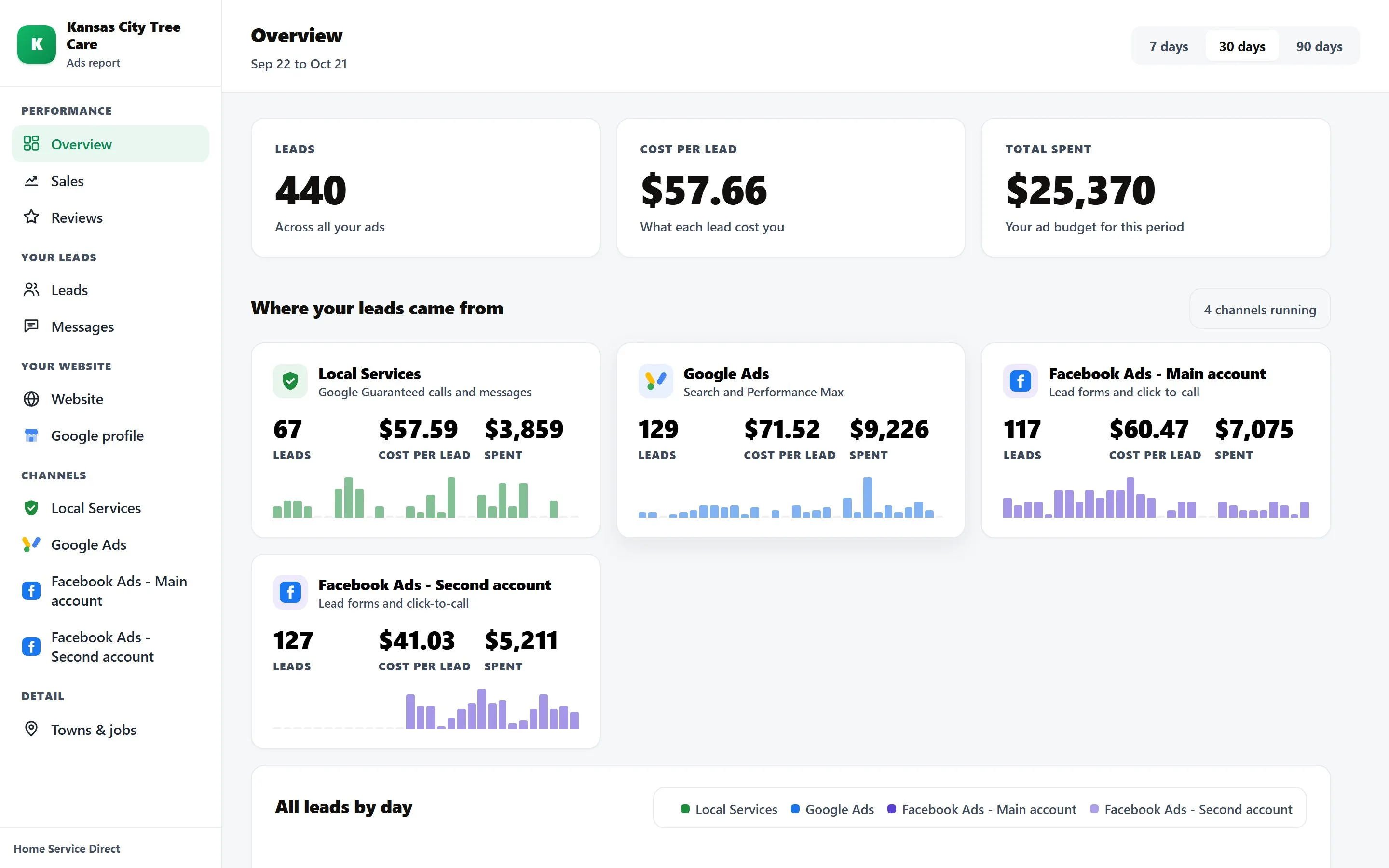
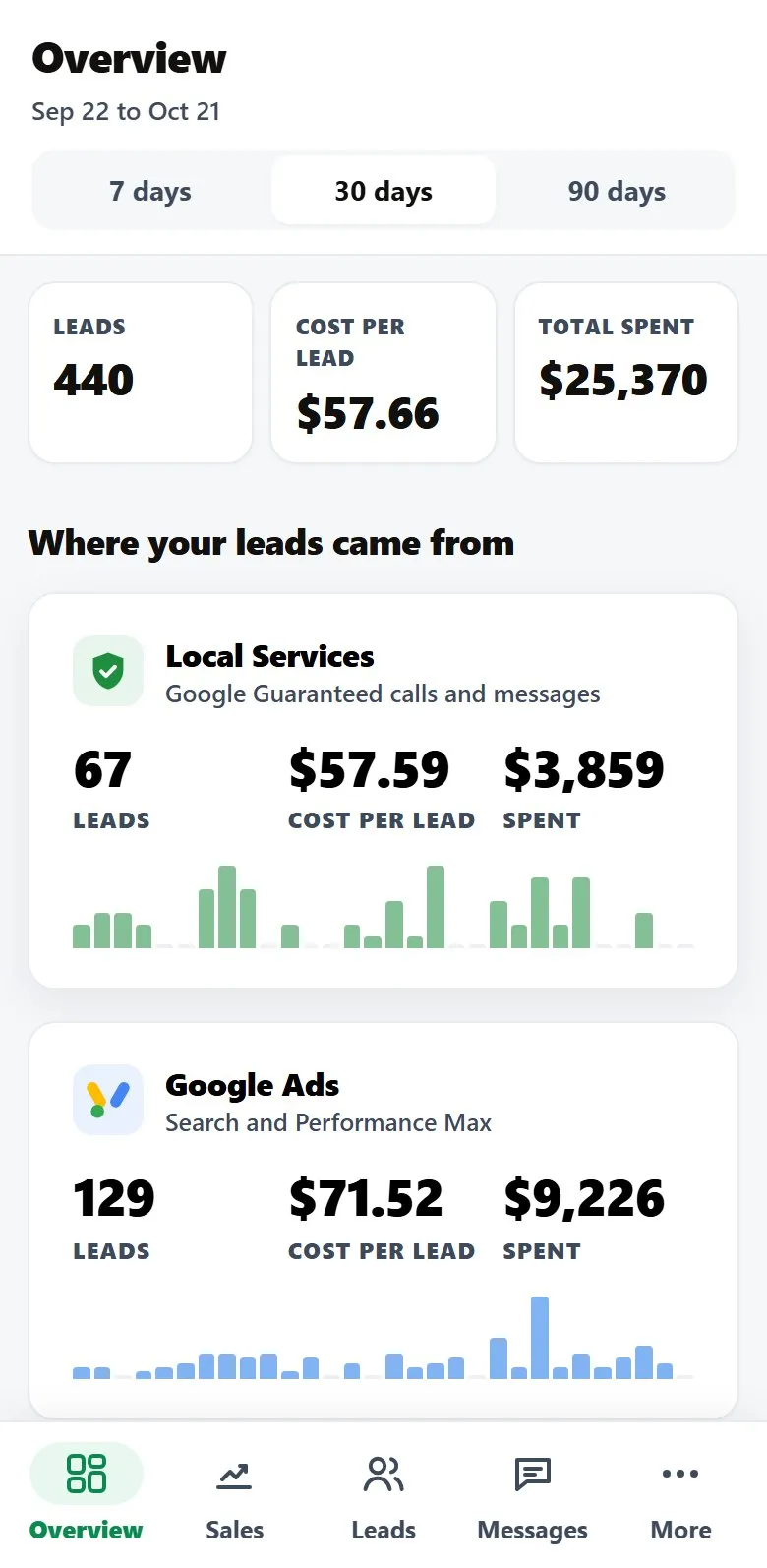
Example dashboard and phone app for a 30-day period. Sample data, shown so you can see the layout.
Google Ads, LSA, SEO, Facebook, YouTube and direct mail, all pulling together. If one has a slow stretch, the others keep crews busy. No more scrambling when a single platform has an off week.
Each week we shift money toward whichever channel, campaign and keyword is bringing in the most booked deck installs. If Facebook starts outperforming Google, the money moves. Your spend keeps following the work your crews most want.
Each call, text and form is tagged with the ad that produced it. When a big composite deck signs, you can see which campaign started it. No black box: you know which channel paid for which job.
Swipe through all 3 points
Why work with us
The Deck Marketing Team
That Handles Every Channel for You
A new deck can be anywhere from $8,000 to $40,000 or more, and most homeowners buy one every ten to fifteen years. Winning that sale takes more than an ad campaign. It takes being a name your town already knows and trusts when the boards rot or they want composite before summer. One team builds that presence across every channel while you keep your boots on the job site.
Home Services Only, Decks Included
Home service contractors are the only clients we take. A homeowner with a rotting deck or a "done before July" deadline is ready now, while someone who is only gathering numbers needs several follow-ups over a few weeks. An agency that markets you like a dental office will not see the difference.
All Channels, One Team
Search, LSA, SEO, Facebook, YouTube, mail, your website and reviews, managed by one team that actually talks. No more web person, ad person and mail vendor each blaming the other two when calls slow.
Growth That Builds, Not Rented Clicks
Ads switch the phone on quickly, but the whole time we are also growing your reviews, rankings and before-and-after gallery. A few months in, more estimates come from people who have seen your decks around town and know your name, rather than from that morning's paid click.
Become the Local Composite Pro Homeowners Choose
Lead marketplaces and manufacturer dealer locators drop you into a list with five other crews. You cannot stop that, so we help you win anyway with Local Service Ads, quick quotes, real project photos and financing offers that make your company the clear local choice.
Accounts and Data Stay Yours
Ad accounts, site, Google listing and every review are held in your company's name. Every estimate shows the channel that produced it and what it cost, down to the click that started a composite build. If you ever leave, everything we built leaves with you. Nothing is held back.
Month to Month, Nothing Hidden
No long-term contract, and you can cancel with 30 days' notice. We skip lock-ins on purpose. Once your town calls you before anyone else and the crews are scheduled weeks ahead, you will have every reason to stay.
Swipe through all 6 reasons
The process
Three Steps to a Fuller Schedule
Each week without a system, the big composite projects near you go to whichever builder quoted first. These three steps put you in that position.
Book Your Call
If there are gaps in your build calendar and you are taking small repairs just to keep crews moving, talk with a marketing team that works only with home service contractors.
Get Your Deck Growth Plan
We lay out the likely sources of your next composite builds and tear-off replacements. You leave with a plan that fits your towns, your crew count and the weeks your season peaks, not a recycled template.
Book More Deck Builds
Real quote requests start coming in, the build calendar fills and install crews are booked weeks ahead, putting more large composite projects in your hands and making you the go-to deck builder in your area.
Swipe through all 3 steps
Pick a Time for My Callor phone us at (555) 010-0000
FAQ
Deck Builder Marketing: Common Questions
How does deck marketing differ from what a general agency offers?
A general agency runs one playbook for dentists, lawyers and deck companies alike. Decks do not work that way. Demand swings hard with the seasons, one composite build can be worth dozens of board repairs, and buyers want to see your past projects and have someone measure and design before they commit.
Home services is all we do, so we plan around the months when decks sell, lead with your own project photos, weight spend toward big composite and two-story builds, and steer people toward a design consult at their home rather than switching on ads and hoping.
I've tried Facebook or Google ads and got nothing. Why try again?
Usually the setup failed, not the channel. Common misses: stock photos instead of your finished decks, targeting the whole metro rather than households with room in the budget for a five-figure project, pointing traffic at the homepage when it needed a page that books a design visit, giving up after three weeks before the ads settled, and no call tracking to show which ad sold the job.
Correct those and the channels that supposedly failed start producing real builds. Rebuilding after a bad campaign is a big part of the work we do for deck companies.
How soon will this marketing pay for itself?
Some channels pay off within days and others build over months, which is why a connected system beats one campaign. Search ads and LSA can make the phone ring within the first week. Facebook typically needs a few days to find its footing. Rankings, reviews and your map listing take a couple of months, then keep producing without a fee on every call.
Because deck work is so seasonal, it pays to keep marketing through winter so spring and summer are booked before competitors restart their ads.
How do you know which marketing is booking jobs?
Each call and form is traced to the channel behind it, which shows you that a $22,000 composite deck began with a paid search click rather than leaving you to guess. You get a plain read on bookings, cost and which towns are producing, instead of vanity charts that never covered an invoice.
When a channel stops producing jobs, we shift the budget to one that does. That's the work.
What should a strong month look like?
During the busy months, a good month for an established crew looks like a full schedule with the big composite and two-story builds ahead of small repairs, plus design visits from people who have seen one of your decks and request you specifically. Early months run smaller while the system and photo library grow.
We work with single-crew owners and multi-crew companies alike, and we plan for growth that holds and pays, not a short burst of price-shopper calls.
My last agency let me down. Why would you be different?
Do not just take our word for it. On the call, ask us anything: how we track leads, what we would change first in your marketing, and what the dashboard you would use looks like.
There's no long-term contract. Your ad accounts, Google Business Profile, leads and call recordings all belong to you. If we're not delivering, you can leave and take everything with you. We'd rather earn each month than hold you to a contract.
Explore more
Explore Our Deck Marketing Services
Decking Leads
Deck leads that go only to you, every monthRead moreDecking Google Ads
Paid search aimed at people ready to hire a builderRead moreDecking SEO
Climb Google Maps in the towns you serveRead moreSwipe through all 3 pages
Next step
Ready to Book Out Your Build Season?
Book a quick strategy call. In 15 minutes we lay out how many composite and replacement deck projects people in your market are searching for now, and how you get to quote them before anyone else.
After You Book
We measure deck search demand in your towns, size up competing builders and pinpoint the wealthier ZIP codes where large composite projects come from.
We walk through the quote requests to expect, what they should cost and the revenue they could add this season.
Exclusive deck quote requests start reaching your phone. No lock-in, cancel with 30 days' notice.
Simple Terms: No long contract, cancel with 30 days' notice. Your accounts, numbers and data belong to you from day one.
One 15-minute call. You get a clear plan built for your service area.
Next step: we'll text or call to schedule your 15-minute strategy session.
Deck Marketing That Fills Calendars, Not Just Dashboards
Marketing a deck company takes more than a single channel. It takes every channel pulling in the same direction. Ads on Google and Facebook and a strong spot in the map only pay off when they run as one system. That separates real deck marketing from someone posting your photos whenever they get around to it. Call it deck advertising or decking marketing, it works only when the pieces are connected.
Thousands Spent on Marketing Last Year, and No Idea Which Part Paid Off
If you cannot say which channel sold your last five decks, what you have is a pile of receipts, not a system. The typical deck company is not short on marketing, it is scattered: some Facebook posts, a yard sign at a finished job, a website an agency built years ago and forgot about, and nothing that shows which dollar turned into a twenty-thousand-dollar composite deck. What follows is how to fix that, from one owner to another.
Why Most Deck Marketing Leaks Money Without Anyone Noticing
The trouble is rarely effort. It is six efforts done halfway instead of three done well. A finished-deck photo gets posted when someone remembers, the Google profile shows four pictures from two seasons back, the ads a general agency built target the bare word "deck" rather than real buyer phrases, and spring calls go unanswered for hours.
Then there is tracking. Without knowing what each booked job cost you, channel by channel, you are deciding budgets blind. You keep paying for whatever seems busiest and may switch off the channel that was actually selling your biggest composite decks. Agencies selling impressions and engagement like it that way, because those numbers always look healthy and never connect to a deck on your schedule.
Bottom line: three channels run well and fully tracked will outperform ten channels you cannot measure, time after time.
The Few Channels That Reliably Book Deck Projects
A long list of marketing ideas will not help. What helps is the four or five that keep putting big-ticket deck projects on the schedule, managed well and aimed at the right neighborhoods:
Google Local Service Ads. The badged listings that lead many local searches. You pay per lead, the lead is yours alone, and it is the spot a homeowner who has already decided to build tends to check first.
Google Search Ads. Catch people searching "Trex deck installation", "composite deck cost" and "deck builder", and send them to a deck page instead of your homepage. The profit comes from bidding up high-value searches and excluding nonsense such as card games and holiday decorating.
Google Business Profile and the Map Pack. Many local clicks happen on the map. A complete profile with plenty of project photos and new reviews arriving every month helps you rank there and lifts your LSA placement too.
Facebook and Instagram. Decks sell with pictures, and social is where people fall for the backyard they want. Your own photos and quick videos of finished composite work, two-story decks and new railings, aimed at the right neighborhoods, plus retargeting for anyone whose estimate stalled over the winter.
Everything else, yard signs, truck wraps and mail to the better subdivisions, multiplies that core rather than replacing it. Build the foundation first, then add the extras.
What Deck Marketing Should Cost, and the Real Price of Cheap
No single figure is right for everyone. Many growing contractors reinvest a set share of revenue in marketing and raise it when they need more work booked or are hiring another crew. Where owners go wrong is grading that spend by what it costs instead of by the decks it books.
The bargain agency at a few hundred a month is often the most expensive choice you can make. It runs one template for deck builders, dentists and plumbers, cannot tell composite from pressure-treated, and bills you while your budget goes to clicks that never book. A low fee saves nothing. It sends the high-ticket decks to whichever competitor runs a real system.
Cost Per Booked Job: The One Number That Matters
Likes and impressions never paid a crew. The figure a deck company should steer by is cost per booked job, meaning a channel's spend divided by the decks it sold. Watch it channel by channel and the right moves become obvious. Put more behind whatever sells big composite builds and cut what brings $400 repairs across the county.
It is also the only fair basis for comparing sources. An LSA lead may be pricier up front than one from Facebook yet cheaper per signed deck, because the buyer is further along. That stays invisible unless call tracking puts a number on every lead, which is what most deck companies lack.
Set Budget by What a Deck Is Worth, Not What a Lead Costs
Decks are high-ticket work, and that should shape how you think about spending. When a typical job leaves thousands in profit, an $80 lead instead of a $30 one is not expensive if it turns into a real composite build. Builders who underfund marketing to trim costs watch crews sit idle, while a competitor who invests enough stays booked for months. Tie the budget to the value of a signed deck, not the price of one lead, and favor the sources that produce large projects.
Deck Marketing Runs on the Calendar
Deck demand is uneven, and your marketing should follow it. Spring and summer bring the call surge and most big composite bookings, so that is when budget goes up and every call needs a live answer. The off season has two jobs: selling repairs and smaller work to keep crews moving, and stacking up reviews and search position that pay off once the weather turns.
Winning builders do not scramble to restart ads when it warms up. They are already ranking well by February because they never shut the system off. People planning a spring deck start shopping in late winter, often to leave time for permits and material orders, and the builder who is visible and well reviewed then books the job before busier competitors are back online.
One Connected System Beats Five Separate Deck Advertising Vendors
The scattered approach carries a hidden cost: a web person who never talks to the ads person, who never talks to whoever manages your Google profile. Leads fall through the gaps, nobody owns the outcome, and you end up connecting the pieces between estimates and job sites.
A connected system solves that. Ads point to landing pages built to convert, calls are traced to their channel, reviews feed rankings, and one team is accountable for cost per booked job across everything. That is the gap between marketing that looks active and marketing that puts decks on the schedule.
Your Site Either Books Jobs or Just Sits There
Great ads still lose the sale when they send people to a slow, generic site. Many deck company websites are online brochures with a logo, one stock image, some bullet points and a contact form at the very bottom. A family weighing a twenty-thousand-dollar deck skips past that. They are looking for proof in your finished projects, a sign you can build what they picture and a quick way to get a price.
A site that books jobs loads quickly on a phone, opens with your best composite and wood projects, shows off the two-story decks and custom railings that set you apart, keeps the call button and form easy to reach, and answers what every buyer wonders: will this company build what I have in mind, and roughly what will it cost. Paying to send traffic to a page designed to look pretty instead of getting the call is money wasted.
Reviews and Photos Decide Which Builder Gets the Call
When a homeowner has three deck quotes, your rating, review count and photo gallery often settle the question of trust before price comes up. Reviews are more than vanity. They are a major factor in how you place in the map results and the Local Service Ads row, and they quietly sell for you inside every ad. A builder at 4.9 stars with a long review history and a wall of finished decks usually beats one at 4.7 with a few dozen.
That makes review requests and a solid project gallery a marketing channel in their own right. Winning builders ask each happy customer for a review on the day the deck is finished, text the direct link and photograph every completed project. It builds on itself: more reviews and better photos help you rank higher and close more often at once. Most deck companies leave all of this to luck.
If You Don't Own Your Accounts, You're Stuck
Here is a trap many owners only notice when they try to switch. The agency sets up the ad account, Business Profile, call tracking and website in its own name, so when the payments end, the agency keeps all of it. You start over from nothing, and they know that, which is why they never need to work hard for you.
Own everything from the first day: ad accounts, Google profile, website, phone numbers and data. A marketing partner that trusts its own work will not object, because it earns your loyalty with booked decks rather than by holding your assets. If an agency will not register your accounts to your company, you already know how that relationship will go.
Deck marketing, digital marketing for deck builders or plain advertising that books jobs, the scoreboard does not change: a full schedule, not vanity numbers. A marketing company that cannot connect spend to signed work is not worth paying.
Vanguard works only with home service contractors, so your trade is not something we pick up at your expense. We build the whole system, including ads, landing pages, Google profile, reviews, project galleries and tracked phone numbers, and we run all of it toward one target: signed deck projects. Everything is tracked, the accounts are yours and there is no long contract. Plenty of activity with open weeks still on the calendar is exactly the problem we fix.
Get My Deck Marketing Plan
One marketing team for home service contractors: ads, SEO, websites and reviews.
Services
Explore
Get in Touch
Want Marketing That Books Out Your Season?
Take a 15-minute call and we will show you how we would fill your schedule with real composite deck projects. No long-term contract, no pressure.