
- Home
- About Us
- Services
- Who We Serve
- Home service trades
- Specialist trades
- Exterior and remodeling
- Outdoor and site work
- Client Reviews
- Book a Strategy Call
Tree Service Marketing That Fills Your Crew Calendar All Year
One team runs your entire marketing program, built around removals, pruning and storm work. Every call is exclusive to you, so you never fight four other crews over the same homeowner the way you do with Angi.
- ✓Google, LSA, SEO, Facebook, YouTube and mail managed together, so one quiet channel never empties your schedule
- ✓Fast channels go live first, so calls start in days, not after a month of meetings
- ✓Month to month, and you own every account we build
One 15-minute call. You get a clear plan built for your service area.
Next step: we'll text or call to schedule your 15-minute strategy session.
Where jobs slip away
Where Does Your Tree Service Marketing Lose Jobs?
Spot the problem your tree company is dealing with, and see where we look first.
Ask which channel booked your last five jobs, and nobody knows
- 1Do you see where each booked job came from, or only a stack of invoices?
- 2Is one vendor running Google Ads, another the website, a third your SEO, with no one owning the whole picture?
- 3Does anyone review your spend with you each month and tell you what to cut and what to grow?
Our first moveEvery lead tracked, plus a single report covering each channel and dollar
Get My Free Marketing Reviewor phone us at (555) 010-0000
To homeowners, you look like every other company quoting the job
- 1Is your Google listing showing your crane, bucket truck and recent jobs, or a handful of stale pictures?
- 2When a homeowner collects three quotes, do your stars and reviews tip it your way?
- 3Does your site open with real project photos and a call button, or stock images and a buried form?
Our first moveReview requests after each job, a tuned Google profile, and a site built to win the work
Get My Free Marketing Reviewor phone us at (555) 010-0000
Visitors look around, then leave without calling
- 1On a phone, does your site load quickly and show a tap-to-call button up top on each page?
- 2Do removals, pruning, stump grinding and storm cleanup each have a dedicated page with real job photos?
- 3How many calls and form fills did the site produce last month?
Our first moveA site built around booking work, with call tracking throughout
Get My Free Marketing Reviewor phone us at (555) 010-0000
Calls slow down and crews sit idle
- 1Do you market only in busy months, then scramble once things slow?
- 2Are past customers left alone, with no check-in and no request for referrals?
- 3Do your reviews and rankings keep growing through the quiet months, so you're set when demand returns?
Our first moveAds planned around your seasons all year, plus steady work on reviews and rankings
Get My Free Marketing Reviewor phone us at (555) 010-0000
Six channels, one lead system
How We Keep Tree Service Calls Coming
Through Six Channels at Once
People hire tree crews out of worry and after bad weather, so the goal is to be a name the homeowner already trusts on the day a limb lands on the house. All six channels run as one connected system, so you show up for tonight's emergency search and stay familiar to the neighborhood between storms.
What Each Channel Adds to Your Schedule
Below is what each channel does, what we handle for you and the kind of tree work it puts on the calendar:
Google Search Ads
Catch homeowners the moment they search
What you get
- ✓Your company appears ahead of the lead marketplaces when someone types "emergency tree service" or "tree removal near me". Those searchers want to book now, and the page they land on plus the tracked phone number show you every job the campaign produced.
What it brings you: callers ready to book
Google Ads (Search)
- ✓Landing pages built and tested to turn clicks into calls
- ✓Wasted clicks cut weekly
- ✓Junk searches blocked before they eat your budget
- ✓Cost per lead tracked and pushed down month by month
- ✓Lead volume sized to your crews
Facebook & Instagram Ads
Be the familiar name in town
What you get
- ✓Get in front of owners with big lots and mature trees well before anything falls.
- ✓Your own crane picks and before-and-after removals catch attention and fill the calendar with planned pruning, thinning and deadwood work that keeps crews moving between storms.
What it brings you: demand before they search
Facebook & Instagram Ads
- ✓Video ads edited from footage of your crews at work
- ✓Aimed at $500K+ homes with larger yards, so fewer bargain hunters see them
- ✓Retargeting follows up with visitors who left
- ✓Leads often cost less than on search
- ✓Removal and pruning requests from planners
Local Service Ads (LSA)
Top-of-page spot with the Google Verified badge
What you get
- ✓We work to put you in the first LSA slot for "tree service near me". The verified badge is what makes a worried homeowner with an oak on the house choose you over the next name, and you are charged only when they call.
What it brings you: badge-backed phone calls
Local Service Ads (LSAs)
- ✓We push you up the list where callers actually look
- ✓No splitting the lead with Angi crews
- ✓The higher you rank, the more your phone rings
- ✓Every invalid lead disputed for a credit
- ✓Calls that go only to you
Google Business Profile & SEO
Show up on the map across your service area
What you get
- ✓We strengthen your Google listing and site for searches like "tree removal company" and "arborist near me", so calls keep arriving without a fee on every click.
- ✓Reviews, fresh job photos and local pages move you into the map results, and unlike ads, that ranking keeps growing in value the longer it is maintained.
What it brings you: calls without click fees
SEO & Organic Search
- ✓Rankings tracked for the searches that bring real jobs
- ✓A steady flow of new Google reviews
- ✓Listings on the directories homeowners really use, chosen for quality
- ✓Organic calls that grow without a click fee
- ✓Your average cost per call keeps sliding down
Direct Mail
Land in the mailboxes of your best neighborhoods
What you get
- ✓A three-piece mail sequence goes to the wooded, higher-value ZIP codes you pick, showing your crew, real removals and a number to call.
- ✓Owners of leaning or overgrown trees often are not searching yet, so the mailer puts your name on the kitchen counter before a storm turns it into an emergency.
YouTube Ads
Show local homeowners your crews at work
What you get
- ✓Your crane and big-removal clips play for local homeowners watching home and garden videos, filtered by property value and shown again to anyone who has been on your site.
- ✓So when that dying oak finally has to go, yours is the company they already remember.
Swipe through all 6 channels
Get My Free Marketing Reviewor phone us at (555) 010-0000
Your live dashboard
A Tree Company's Month, Tracked End to End
This is the kind of dashboard and app you get.
Build My Channel Plan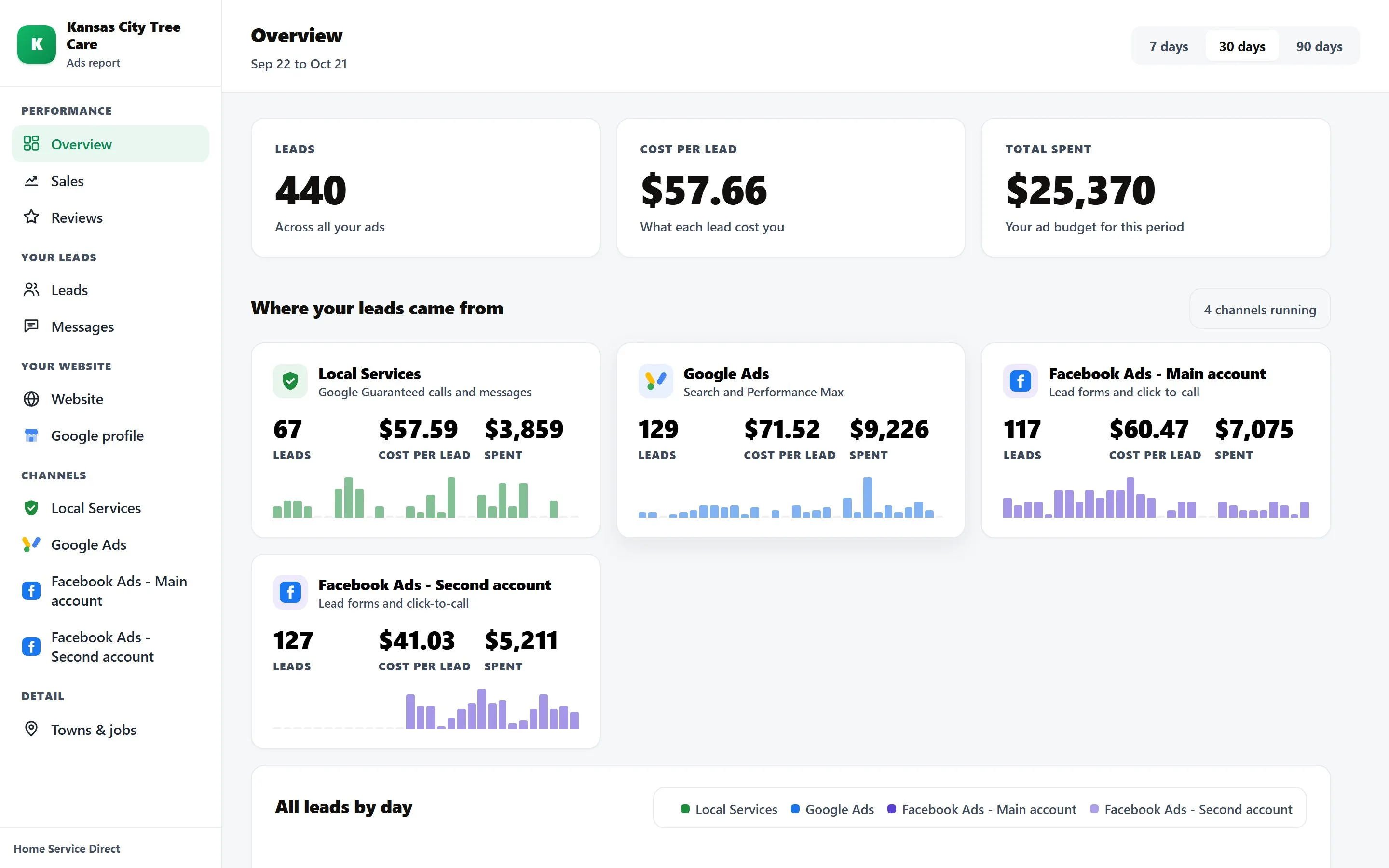
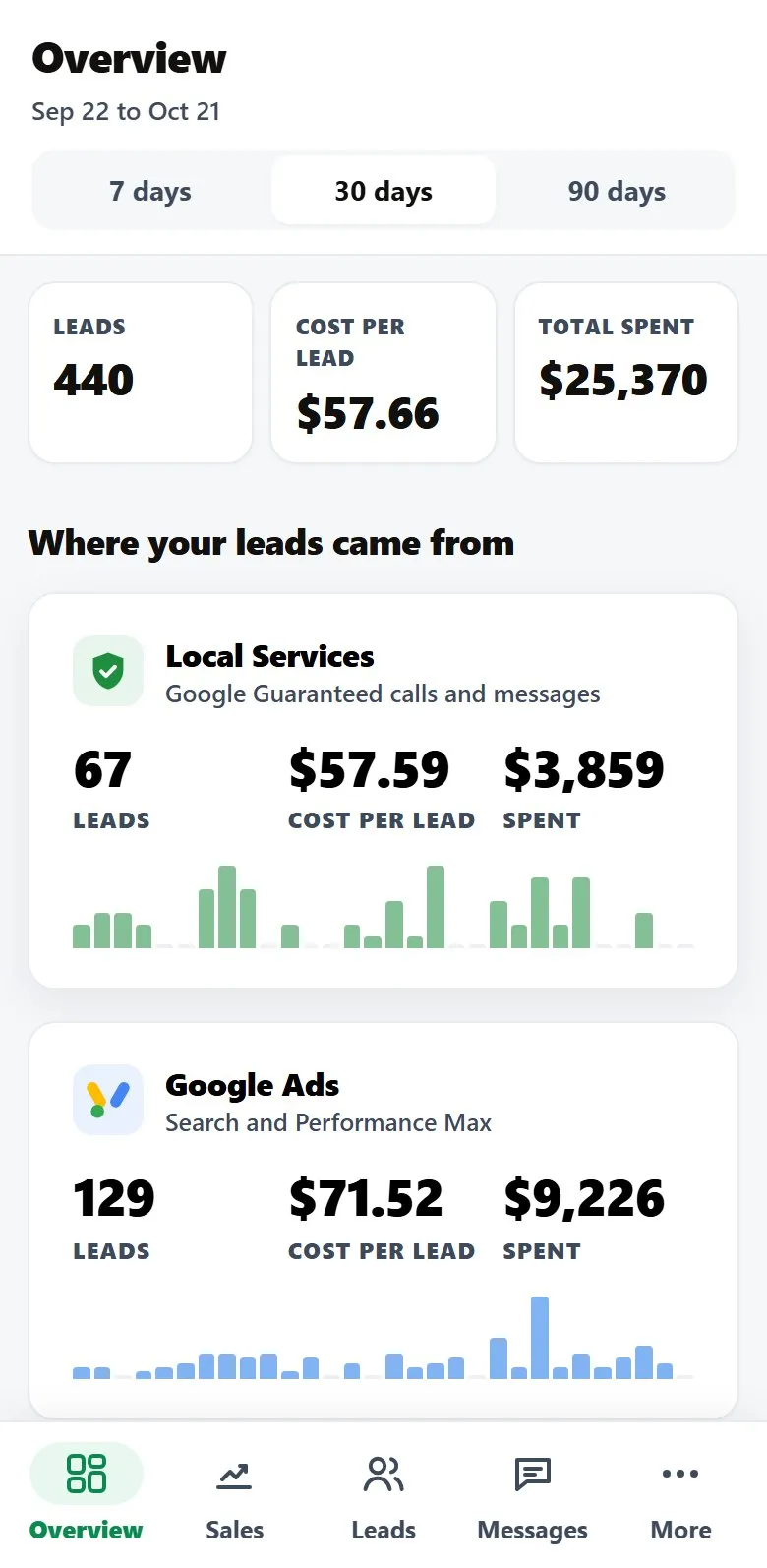
Example dashboard and phone app for a 30-day period. Sample data, shown so you can see the layout.
Google Ads, LSA, SEO, Facebook, YouTube and direct mail, all pulling together. If one has a slow stretch, the others keep crews busy. No more scrambling when a single platform has an off week.
Each week we move money toward whichever channel, campaign and keyword is producing booked tree jobs. If Facebook starts outperforming search, the budget shifts with it. Your spend keeps chasing your best work.
Each call, text and form is tagged with the ad behind it. A large storm removal might trace back to a single $48 click, and you would see it. No black box: you know what every campaign earned.
Swipe through all 3 points
Side by side
What Sets Us Apart From Other Agencies
There are three common ways to find more tree work. Only one puts every lead in your hands alone, under your own name, with nothing locking you in.
Vanguard Home Services Marketing
- Who Gets the Lead
- ✓Only You
- Specialists in Tree Service
- ✓Tree-Focused
- Results Tracked to Booked Jobs
- ✓Every Job Tracked
- Commitment
- ✓Monthly Terms
- Channels Covered
- ✓Six Channels
- Account Ownership
- ✓All Yours
- Typical Close Rate
- 70-80%
Typical Agencies
- Who Gets the Lead
- ✓From Your Ads
- Specialists in Tree Service
- ✕Every Industry
- Results Tracked to Booked Jobs
- ✕Not Tracked
- Commitment
- ✕Long Lock-In
- Channels Covered
- ~One or Two
- Account Ownership
- ✕The Agency's
- Typical Close Rate
- 45-55%
Shared Lead Sites
- Who Gets the Lead
- ✕Sold to Several
- Specialists in Tree Service
- ✕Not Trade-Specific
- Results Tracked to Booked Jobs
- ✕Not Tracked
- Commitment
- ~Lead Count Only
- Channels Covered
- ✕Their Platform Only
- Account Ownership
- ✕The Platform's
- Typical Close Rate
- 25-35%
Swipe through all 3 options
Exclusive or Shared: Running the Close-Rate Numbers
A shared lead goes out to several contractors at the same moment. The homeowner gets swamped, and few of those leads ever close. Exclusive tree service leads reach one company, so there is no bidding war and no race to dial.
Example: 10 shared leads, $30 apiece ($300), closing at 7% = 0.7 jobs. 5 exclusive leads, $60 apiece ($300), closing at 45% = 2.25 jobs. Same budget, roughly three times the work.
Why One Lead Is a $500 Job and Another Is $5,000
The type of job matters too. A removal often brings in several thousand dollars, many times what a $300 to $800 trim pays. When leads are sorted by service, you can put your effort into the work that pays most.
We aim at big removals, storm damage and hazard trees, not just pruning requests worth $200.
or phone us at (555) 010-0000
Why work with us
A Complete Marketing Team, Focused on Growing Tree Companies
We handle the full marketing program for home service companies, tree crews included. Website, Google Ads, Facebook, map rankings, reviews and follow-up all sit with one team. The goal is simple: you stop chasing leads and start owning your market.
Home Services Is All We Market
We do not take dentists or law firms. We can tell which channels land a big storm removal and which bring small trims, and your plan leans toward the bigger tickets.
We Handle Marketing. You Run Crews.
You started a tree company to climb, rig and cut, not to run ad accounts, beg for reviews and sit by the phone. We act as the marketing department you would never hire full time, so your time stays on the job site.
Growth You Keep, Not Just Calls You Rent
Ads switch the phone on quickly, but the whole time we are also growing your review count, your map position and your reputation. Over the months, a growing share of jobs comes from people who already know your company rather than from a click bought that morning.
Six Channels Running Around the Clock
Google Ads, LSA, SEO, Facebook, YouTube and mail. When the storm rush fades or a platform hits a dry spell, the rest keep the phone busy and the crews scheduled.
Accounts and Data Stay Yours
Your ad accounts, site, Google listing and reviews are registered to you. You can see which channel produced each job and its cost. Should you ever move on, everything you built goes with you. Nothing is held back.
Month to Month, Nothing Hidden
No long-term contract, and you can cancel with 30 days' notice. We skip lock-ins on purpose. Once your town calls you before anyone else and the crews are scheduled weeks ahead, you will have every reason to stay.
Swipe through all 6 reasons
The process
Keeping Your Crews Booked in Three Steps
When a branch crashes onto a roof tonight, the family will call whichever tree company they find first. Right now that may not be you. Here is how we change that in each town you serve.
Book Your Call
If the chipper and bucket truck sit parked between storms, or you still buy Angi leads that five other crews also get, book a call with a team that markets only home service companies.
Leave With a Plan
We point out where the large takedowns and crane work near you are, and which channels win them versus which only bring in $400 trims. You finish the call knowing where next month's tree work will come from.
Fill Your Schedule
We switch on all six channels, fill your calendar with removals and larger pruning jobs, and protect the LSA badge and map ranking that put you first in line after a storm.
Swipe through all 3 steps
Pick a Time for My Callor phone us at (555) 010-0000
FAQ
Tree Service Marketing: What Owners Ask Us
How does tree service marketing differ from what a general agency offers?
An all-purpose agency uses one playbook for dentists, lawyers and tree crews. Tree work doesn't fit it. Calls surge after storms and through the growing season, a hazard removal can be worth many times what pruning pays, and someone with a branch through the ceiling calls whoever answers first, not whoever has the nicest site.
Home service is all we do, so we plan around storm season, put more of your spend behind removals and storm work, and fix how fast leads get answered instead of switching on ads and hoping.
I've tried Facebook or Google ads and got nothing. Why try again?
Nearly always, the setup failed, not the channel. Common problems: stock images in place of your own crews and crane, targeting a 50-mile circle rather than homes with large mature trees, sending traffic to the main page rather than one designed for calls, stopping after three weeks before the campaign could learn, and no tracking to show which ad booked anything.
Correct those and the channels that "failed" begin booking removals. Cleaning up after a bad campaign is a big share of our work with new tree clients.
How soon will this marketing pay for itself?
Some channels pay off within days and others build over months, which is why we run a full system rather than a single campaign. LSA and search ads can get the phone ringing inside a week. Facebook typically needs a few days to find its footing. SEO, reviews and the Google Business Profile need a couple of months, then keep bringing in calls without a per-click charge.
We begin with the quick channels so work gets booked early, then build rankings and reviews underneath so that, over time, more jobs arrive without paying for every one.
How do you know which marketing is booking jobs?
Each call and form carries a tag for its source, so instead of guessing, you can see that a $60 LSA call became a $4,200 removal. Every week you get a plain summary of booked jobs, their cost and the zip codes producing them, not a screen of vanity stats that never covered a bill.
When a channel stops producing jobs, we shift the budget to one that does. That's the work.
What should a strong month look like?
For an established crew on the full system, a good month means a booked-out calendar with big removals and storm jobs ahead of small trims, and a healthy share of calls from homeowners who recognized you already. The first months run lighter while the system and your reputation build.
We work with one-truck owners and multi-crew operations alike, and we aim for growth that is steady and profitable, not a short burst of bargain-hunter calls.
My last agency let me down. Why would you be different?
Ask us anything on the call. We will show you exactly how we track calls and report booked jobs, and with no long contract, you can judge us on results month by month.
There's no long-term contract. Your ad accounts, Google Business Profile, leads and call recordings all belong to you. If we're not delivering, you can leave and take everything with you. We'd rather earn each month than hold you to a contract.
Explore more
See More Ways We Grow Tree Companies
Tree Service Leads
Exclusive tree leads sent straight to your phone each monthRead moreTree Service Google Ads
Top spots on Google for ready-to-hire tree searchesRead moreTree Service SEO
Climb Google Maps in the towns you serveRead moreSwipe through all 3 pages
Next step
Ready to Keep Every Crew Busy All Year?
Spend 15 minutes with us on a strategy call. You will see how many removals, crane picks and large pruning contracts are available near you this month, and how your name gets in front of those buyers.
After You Book
We size up competing tree companies, how often people near you search for storm help and removals, and the wooded, higher-value zip codes worth going after.
We go over how many tree calls your market can realistically produce, the cost by channel and the removal revenue that can add up to.
Exclusive tree calls begin ringing your phone and no other crew's. No long-term contract, cancel with 30 days' notice.
Our commitment: No long contract, no lock-in. Your accounts belong to you, and every call and booked job shows up in plain numbers.
One 15-minute call. You get a clear plan built for your service area.
Next step: we'll text or call to schedule your 15-minute strategy session.
Tree Service Marketing That Fills Schedules, Not Reports
Marketing a tree company is not a single channel. It is every channel working in the same direction. Search ads, social ads and map listings only pay off as one system, and they only stay affordable when you know what a tree lead should cost. That is what separates a real marketing program from a freelancer who boosts a post now and then.
Thousands Spent on Marketing Last Year, and No Idea Which Part Paid Off
If you cannot say which channel brought in each of your recent tree jobs, what you have is a pile of invoices, not a system. Most tree businesses are not short on marketing. They are spread thin: some Facebook, a few yard signs, a website an agency built and abandoned, and no idea which dollar became a crane job. What follows is a practical fix, one owner to another.
Why So Much Tree Service Marketing Leaks Money
The issue is rarely too little activity. It is six efforts done halfway rather than three done properly. A post gets boosted when someone remembers, the Google profile has four photos from years ago, the ads an agency set up bid on the vague word "tree", and storm calls ring out because nobody picks up on the first ring.
Then comes tracking. Without knowing what each booked job cost per channel, you are setting budgets on a hunch. You keep paying for whatever feels busy and drop the effort that was quietly bringing in your biggest removals.
Bottom line: three channels run properly with every lead tracked will beat ten channels you cannot measure.
What Tree Service Advertising Costs, Channel by Channel
Each channel has its own cost pattern, and knowing it ahead of time stops you from overspending on a weak channel or starving a strong one. Google Local Service Ads charge per lead and often deliver the best return for tree companies, since the person calling wants to hire and Google has already verified you. Google Search Ads cost more per lead but still close well, and they earn their place once LSA volume caps out or when you want to target one job type, such as crane removals. Facebook and Instagram leads usually cost less but are less urgent, because those people were scrolling a feed, not hunting for a tree crew. Direct mail costs more per contact but still books real jobs, especially in the streets around a job your crew just finished.
None of those costs mean much without your close rate beside them. A $70 lead that becomes a $4,000 takedown is the best spend of your month. A $20 lead three towns over who never picks up is a write-off, not a deal.
The Few Channels That Really Book Tree Work
You don't need fifteen marketing ideas going at once. Tree companies with steady lead flow usually aren't using secrets. They chose four or five channels, ran them well and dropped the rest. Focus on these:
Google Local Service Ads. The verified badge that leads the page. Billed per lead, exclusive to you and the most ready-to-hire spot there is when storms send people searching. Emergency calls land here first.
Google Business Profile and the map results. A large share of local clicks go to the map. A complete profile with new job photos and fresh reviews arriving every month earns you a place there and boosts your LSA ranking too.
Facebook and Instagram. This is where you build demand before the storm. Crane and bucket-truck footage shown to owners of valuable homes on wooded lots, plus retargeting for homeowners who received an estimate and went silent.
Everything else, from direct mail and YouTube to truck wraps and yard signs, multiplies that core. It does not replace it. Get the core running well, and only then layer on the rest.
Stop Selling on Price. Win the Job Before You Quote It.
If a homeowner can't tell your truck from the other three quoting the same oak, price decides it. Wrapped trucks, clean uniforms, a modern logo, an ISA certified arborist on the crew and your insurance and license shown everywhere are what let your $4,200 bid beat a $2,900 one, because the customer already sees you as the safe choice. It is the most overlooked lever in tree marketing, and most owners skip it because it never appears on a lead report.
Reviews Are Marketing That Decides Who Gets Hired
When a homeowner collects three quotes, the rating and number of reviews often settle who seems trustworthy before money is discussed. Reviews also drive your position on the map and in the LSA lineup, and they back up every ad you run. A company with hundreds of strong reviews usually beats one with a few dozen.
So treat review requests as a marketing channel. Ask each satisfied client on the day the chipper leaves, not by email days later, since same-day asks get far more responses. Reply to every review quickly, positive or negative. It builds on itself: more reviews lift rankings, rankings bring calls, and calls bring more reviews.
Your Website Books the Job or Hands It to a Competitor
Great ads still lose jobs when they land on a slow, cookie-cutter site. Many tree company sites are brochures: logo, stock image, service list and a contact form at the bottom. Someone whose garage just took a falling trunk is not reading a brochure. They need your number, evidence you handle this kind of job and a quick path to an estimate.
A site that books work loads quickly on a phone, opens with your actual crews and crane in action, and keeps the call button where a stressed homeowner can see it. Lifting conversion from 2 percent to 8 percent turns the same ad budget into four times the booked jobs without buying any extra traffic. Repair the site first, then put more money into ads that send people there.
Work Your Past Customers Before Buying Another Lead
Every customer on your list cost money to win, yet most tree companies forget them and pay again to reach strangers. A yard full of mature trees will need pruning again before long, so walk the property and quote that next job before you pull out. Offer a real referral reward, and check in with past customers before storm season and again before winter pruning. Growing repeat and referral work often beats raising ad spend, and it costs very little.
Tree Service Marketing Runs on Seasons
Tree demand rises and falls, so your marketing should too. Storm season and the growing months bring the expensive emergency removals, so that is when you spend hardest and make sure every call is answered live. In the quieter months, fill the calendar with winter pruning and scheduled maintenance, and grow the review count and map position you will lean on once storms return.
The winners don't panic and spend after a storm passes. They already sit at the top of the results when it hits, because they kept everything running through the slow months.
Cost Per Booked Job: The One Number That Matters
Likes, impressions, clicks and reach don't pay a crew. The number that decides whether you profit is cost per booked job: channel spend divided by the jobs it produced. For every channel, watch the price of a lead, how many close and the average ticket, and decisions get easy. Grow what lands big removals and drop what lands $200 stump jobs two towns away.
It is also the only fair way to compare channels. One LSA call can cost more than several social media leads yet still produce jobs at a lower cost, because the caller is more serious. You can't see that unless call tracking gives every lead its own number, which is what many tree companies lack.
If You Don't Own Your Accounts, You're Stuck
Here is a trap many owners only notice when they try to switch. The agency sets up the ad account, Business Profile, call tracking and website in its own name, so when the payments end, the agency keeps all of it. You start over from nothing, and they know that, which is why they never need to work hard for you.
From the first day, insist that you own it all: ad accounts, Google profile, website, phone numbers and data. A partner who trusts its own work won't object, because it keeps clients by producing work rather than holding their assets.
Tree service marketing, tree company advertising, marketing that books tree jobs: whatever you call it, the scoreboard is a full schedule, not vanity numbers. A marketing company that can't link each dollar to booked work, one channel at a time, isn't worth paying.
Here is what we do. We build the full system, from ads and landing pages to your Google profile, reviews and call tracking, and we manage all of it toward one number: booked tree jobs. Every lead is tracked, the accounts are yours and there is no long contract. If marketing keeps you busy but the calendar still has gaps, that is what we fix.
Build My Tree Marketing Plan
One marketing team for home service contractors: ads, SEO, websites and reviews.
Services
Explore
Get in Touch
Ready for Tree Service Marketing That Keeps Crews Working?
Book a short call and we will show you which channels win the big takedowns and crane work near you. No long-term contract, no pressure.